
How to Use AI to Qualify Leads Before They Reach Your Sales Team

How to Use AI to Qualify Leads Before They Reach Your Sales Team

Generating leads is only the beginning of the sales process. The bigger challenge is understanding which enquiries are genuinely relevant, what each prospect needs, and whether the sales team has enough information to continue the conversation effectively. As businesses generate leads through WhatsApp, Instagram, websites, advertising campaigns, social media, and other digital channels, managing the initial stage of every enquiry manually can become increasingly difficult.

Not every person who contacts a business is at the same stage of the buying journey. Some prospects already know exactly what they need, while others are still exploring their options. Some may meet the company’s requirements immediately, while others may have different expectations around budget, location, timeline, product specifications, or service requirements. When every enquiry is passed directly to sales, team members often spend a significant amount of time asking the same initial questions before they can determine how the conversation should proceed.

This is where AI lead qualification can become useful. Instead of replacing the salesperson, AI can support the initial stage of the conversation by asking relevant questions, collecting important information, understanding customer requirements, and organizing responses according to criteria established by the business. Automation can then use that information to determine the appropriate next step, whether that means assigning the enquiry to a salesperson, moving it into a particular pipeline stage, routing it to a specific department, or requesting human involvement.

By the time the conversation reaches the sales team, the salesperson can have much more context about the prospect, their requirements, and what needs to happen next. The purpose is not to remove human interaction from sales, but to make sure salespeople spend less time collecting repetitive information and more time working with opportunities that require their expertise.

What Is AI Lead Qualification?

Lead qualification is the process of collecting and evaluating information about a prospect to understand whether an enquiry is relevant to the business and determine the most appropriate next step. The qualification criteria can vary significantly depending on the industry, product, service, customer type, and sales process.

For example, a real estate company may want to know a prospect’s preferred location, property type, budget, and expected purchase timeline. An education business may need information about the student’s preferred course, educational background, location, and intended intake. A B2B software provider may want to understand the company’s size, current systems, required integrations, business challenges, number of users, and expected implementation timeline.

The purpose of qualification should not simply be to label someone as a “good” or “bad” lead. Effective qualification creates context around the enquiry so the business can understand what the prospect needs and determine how the conversation should proceed. Some information may affect whether an opportunity progresses, while other information may simply help the salesperson prepare for a more relevant conversation.

Traditionally, salespeople collect this information manually during the first interaction. AI lead qualification allows businesses to automate part of this initial discovery process while keeping human involvement available whenever the conversation requires judgment, negotiation, detailed consultation, or a more personalized discussion.

Why Manual Lead Qualification Becomes Difficult as Enquiries Increase

Manual qualification can work well when a business receives a relatively small number of enquiries. A salesperson can open each conversation, introduce themselves, understand the requirement, ask a few questions, and decide what should happen next. As enquiry volumes increase, however, repeating this process across dozens or hundreds of conversations can consume a significant amount of sales time.

Consistency can also become a challenge. One salesperson may collect five important details while another collects only three. During busy periods, certain questions may be missed completely, and prospects may have to wait several hours before someone is available to begin the initial conversation. Even when the required information is collected, it may remain buried inside individual chat histories rather than being organized into useful data for the wider sales process.

This creates an operational problem beyond simply responding to more messages. The business needs a structured method for understanding incoming enquiries, collecting consistent information, and deciding where those conversations should go. AI qualification can create this initial structure before a salesperson becomes directly involved.

How AI Lead Qualification Works

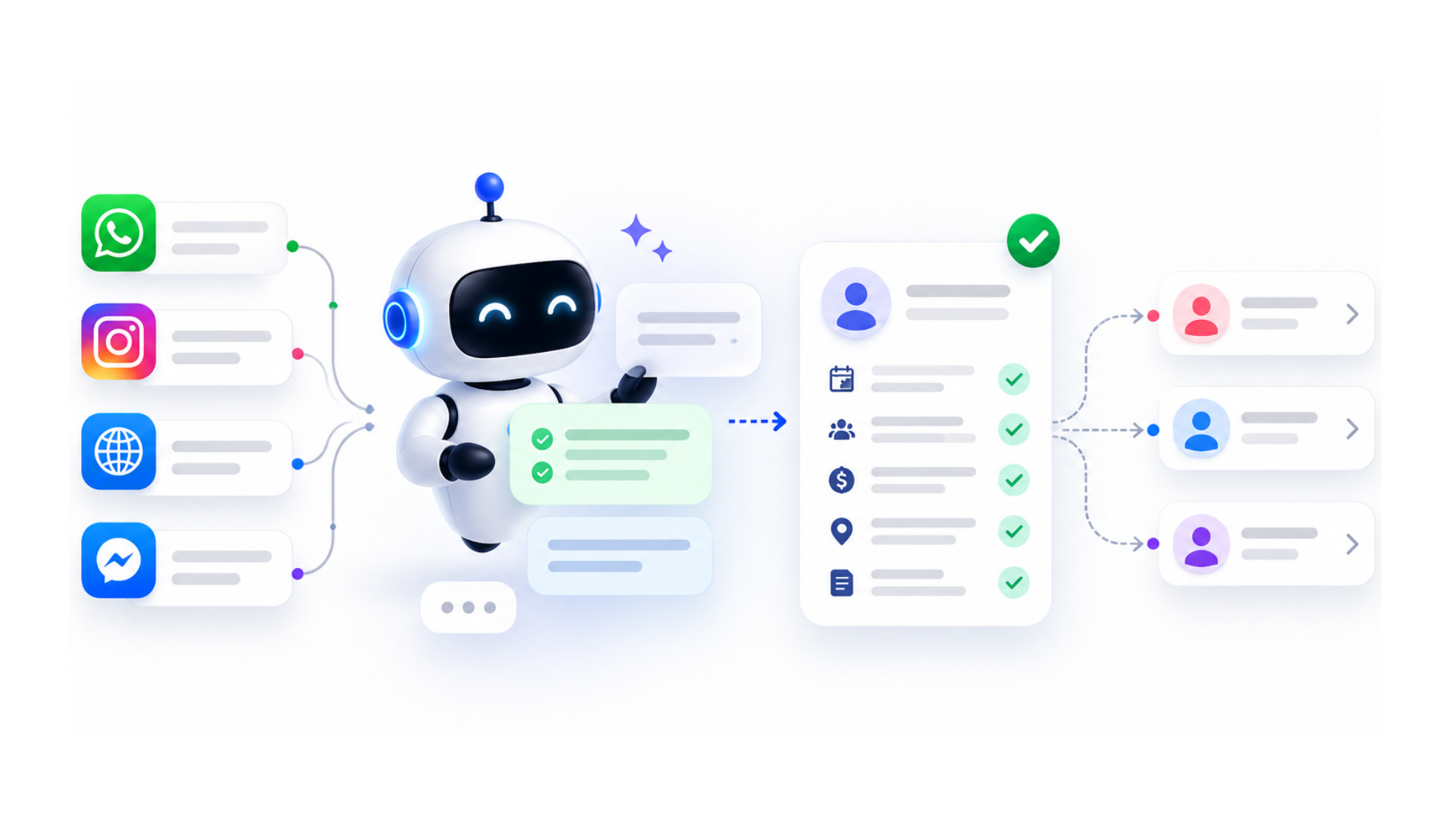
AI lead qualification introduces an automated discovery stage between the initial enquiry and the sales conversation. When a prospect contacts the business, an AI system can interpret the message, identify information that has already been provided, and continue the conversation by collecting the details the business considers important.

Suppose a potential customer contacts a software company and says that they need a CRM for their sales team. Instead of immediately transferring the conversation to a salesperson, the AI can begin the initial discovery by asking about the number of users, the current sales process, existing software, required integrations, major operational challenges, implementation timeline, or other information relevant to the company’s qualification process.

Unlike a rigid questionnaire, an AI-based conversation can also take existing context into account. If the prospect has already mentioned that they have 25 users and need implementation within two months, there is little value in asking for those details again. The AI can identify what information is still missing and continue from there, making the interaction more contextual while still ensuring that the business collects the information required for its sales process.

Once the necessary details have been collected, predefined automation rules can determine what happens next. The enquiry might be assigned to a particular salesperson, categorized according to the customer’s requirement, moved into a sales pipeline, tagged for future segmentation, or transferred to a human for further discussion. AI manages the conversational part of the discovery process, while the business continues to define the qualification criteria and actions that follow.

Start by Defining What a Qualified Lead Means

An AI qualification process can only be as useful as the criteria behind it. Before implementing automation, businesses need to identify what information their sales team currently uses to understand and evaluate an enquiry. Without clearly defined criteria, adding AI can simply automate an unclear process rather than improve it.

Depending on the business, qualification information may include budget, location, company size, product or service requirements, urgency, purchase timeline, use case, number of users, current systems, order quantity, or another business-specific factor. However, not every piece of information needs to determine whether a prospect progresses to the next stage.

Some details may simply provide useful sales context. A software provider, for example, may want to know which system a prospect currently uses even if that information does not determine qualification. Knowing it beforehand can still help the salesperson prepare for discussions about migration, integration, implementation, or compatibility.

Businesses should therefore distinguish between information that directly influences qualification and information that simply improves the sales conversation. Making this distinction keeps the process focused and prevents prospects from being asked unnecessary questions before they can speak with the team.

Use AI to Collect Only the Information That Is Missing

One of the practical advantages of AI-based qualification is its ability to work with conversational context. Traditional forms and fixed chatbot flows generally follow a predetermined sequence in which every prospect receives the same questions, regardless of what they have already explained.

Consider a prospect who sends a message saying, “I need a solution for a team of 25 people. We currently manage enquiries manually and want to implement something within the next two months.” That single message already provides the team size, current challenge, and approximate implementation timeline. A well-designed AI qualification workflow should recognize those details rather than asking the customer to provide them again.

The AI can instead determine which required information is still missing and continue the conversation accordingly. If the business also needs to know which communication channels the company uses or whether it has an existing CRM, the conversation can move directly to those questions. This makes qualification feel less like completing a form and more like having a relevant initial discussion.

The objective should not be to maximize the amount of information collected. It should be to gather the information that genuinely helps the business understand the opportunity while minimizing unnecessary effort for the prospect.

Combine AI With Clear Business Rules

AI can understand conversational information, but businesses should avoid relying entirely on an AI model to make subjective qualification decisions. Most organizations already have operational rules that determine how particular enquiries should be handled, and these rules can work alongside AI.

For example, a company may serve only particular geographic regions, while certain products may require a minimum order quantity. Enterprise enquiries may need to be assigned to a senior salesperson, whereas existing customers may need to be routed to an account manager rather than the new-sales team. Similarly, enquiries for different services may need to reach different departments.

In these situations, AI can collect and interpret the information required to apply the rule, while automation determines the corresponding action. Once the prospect provides a location, the workflow can check whether that region is supported. Once the number of users or required service is known, the enquiry can be routed to the appropriate team. If the prospect asks for human assistance at any point, the automated conversation can stop and a salesperson can take over.

Combining conversational AI with predefined business rules gives companies greater control over qualification. AI handles the flexible conversation, while clearly defined workflow logic determines what happens to the enquiry once relevant information becomes available.

Route Qualified Leads to the Right Salesperson

Qualification becomes considerably more useful when it is connected directly to lead routing. Collecting information is only one part of the process; the business must also determine who should handle the enquiry once the initial requirements are understood.

Not every lead needs to enter the same sales queue. Businesses may assign conversations according to location, product, service category, language, customer type, enquiry value, existing ownership, or other criteria. In other situations, qualified leads may simply need to be distributed evenly among available salespeople using a round-robin assignment process.

Connecting qualification with routing means the salesperson receiving the enquiry can already have the relevant context. Instead of seeing only a notification that a new WhatsApp or website lead has arrived, the salesperson may already know the prospect’s requirement, location, expected timeline, selected product, company size, or other information collected during the initial conversation.

This allows the human conversation to begin at a more useful stage. The salesperson does not need to restart the discovery process from the beginning and can instead focus on understanding the opportunity in greater depth, answering questions, recommending the appropriate solution, and moving the conversation forward.

Keep Qualification Data Connected to the Sales Pipeline

Information collected during qualification becomes far more useful when it is connected to the wider sales process rather than remaining only inside the conversation history. If salespeople need to reopen and reread an entire chat every time they want to understand an enquiry, much of the operational benefit of qualification is lost.

Important details can instead be stored in structured fields, tags, lead attributes, pipeline stages, notes, or other records used by the sales team. Once the required qualification information has been collected, automation might move an enquiry from New Enquiry to Qualified, assign an owner, apply an appropriate category, and preserve the relevant customer details for the salesperson.

Connecting conversation data with the sales pipeline also makes that information more useful later. Teams can use structured data for segmentation, reporting, follow-up workflows, sales analysis, and understanding which types of enquiries are entering the business through different sources.

The qualification process therefore should not end when the AI finishes asking questions. The information needs to become part of the operational sales workflow so that it remains useful throughout the rest of the customer journey.

Know When AI Should Hand the Conversation to a Human

Not every conversation should remain automated until every qualification field has been completed. Prospects may ask complex questions, request quotations that require manual review, want to negotiate, explain unusual requirements, or simply prefer to speak directly with someone.

A well-designed qualification workflow should account for these situations from the beginning. Businesses can define circumstances in which automation should stop, a salesperson should be notified, or the conversation should immediately be transferred to a human. These circumstances might include explicit requests for assistance, high-value enquiry types, complex product questions, sensitive situations, or cases where the AI does not have enough information to respond appropriately.

Human handoff is therefore not a failure of AI qualification. It is part of the design. Automation should manage the stages where it can reliably reduce repetitive work, while people should remain available for situations where experience, judgment, negotiation, or a more nuanced conversation creates greater value.

The objective is not to make it difficult for prospects to reach the sales team. It is to ensure that automation helps where appropriate without becoming a barrier between the customer and the business.

Avoid Turning Lead Qualification Into an Interrogation

Once businesses begin automating qualification, there can be a temptation to collect as much information as possible before allowing an enquiry to progress. This can quickly create unnecessary friction for prospects.

If someone needs to answer ten or fifteen questions before receiving meaningful assistance, the qualification process itself can become an obstacle. The business may gain more information, but it also increases the possibility that the prospect leaves the conversation before reaching a salesperson.

A better approach is to identify the minimum information required to determine the appropriate next step. If five details give the sales team enough context to continue the conversation effectively, there may be little benefit in collecting twelve. Additional information can always be gathered later when it becomes relevant.

Businesses can also use progressive qualification, where basic information is collected during the initial interaction and more detailed requirements are discussed once the prospect reaches the appropriate salesperson. Effective qualification should improve the next conversation rather than make customers work unnecessarily hard to reach it.

Apply Lead Qualification Across Different Enquiry Sources

Businesses rarely generate leads through only one communication channel. A potential customer may arrive through WhatsApp, Instagram, Facebook, website chat, an advertising campaign, or another digital touchpoint. Without a consistent qualification process, the quality and amount of information reaching the sales team can vary depending on where the conversation started.

A centralized AI qualification workflow can help businesses apply similar qualification logic across multiple entry points while still adapting the conversation to the channel and customer context. The source may be different, but the underlying business requirements for understanding the enquiry often remain similar.

This becomes particularly useful for organizations running multiple marketing campaigns or managing significant enquiry volumes across different communication platforms. Rather than creating disconnected qualification processes for each source, the business can build a more consistent approach to collecting information and routing leads.

The sales team can then receive structured context regardless of whether the original conversation began on WhatsApp, Instagram, a website, or another supported channel.

Measure Whether AI Lead Qualification Is Actually Helping

Automation should not be considered successful simply because it reduces manual work. Businesses should evaluate whether the qualification process is actually improving the quality, consistency, and efficiency of their sales workflow.

Useful indicators can include whether salespeople are receiving enough information before taking over, how many prospects complete the qualification process, how quickly qualified leads are assigned, whether enquiries are reaching the correct teams, and whether certain questions regularly cause prospects to abandon the conversation. Businesses can also compare different lead sources to understand which channels or campaigns are generating enquiries that match their requirements.

These insights can reveal where the workflow needs improvement. A qualification process may contain unnecessary questions, routing criteria may need adjustment, or salespeople may require additional information before they can continue effectively.

Qualification criteria can also change over time as products, pricing, markets, customer behaviour, and internal sales processes evolve. AI lead qualification should therefore be treated as an operational workflow that is reviewed and refined rather than something that is configured once and left unchanged.

How ihakimi Can Support AI Lead Qualification

With ihakimi, businesses can create lead qualification workflows that combine AI-powered conversations with structured automation. AI Agents can manage the initial interaction, understand customer responses, and collect relevant information according to the requirements defined by the business.

Once the required information is available, automation workflows can use conditions and actions to determine what should happen next. Depending on the process, an enquiry can be tagged, assigned to a team member, moved through a sales pipeline, routed according to predefined criteria, or transferred to a human when direct involvement is required.

Because ihakimi brings conversations from multiple communication channels into a centralized environment, businesses can also apply qualification workflows across different customer entry points instead of managing each source as a completely separate process. The information gathered during conversations can become part of a broader workflow involving lead management, routing, pipeline movement, follow-ups, and human handoff.

The purpose is not to remove salespeople from the customer journey. It is to help ensure that when a salesperson enters the conversation, useful information is already available. Instead of spending the beginning of every enquiry collecting the same basic details, the sales team can focus more of its time on understanding the opportunity, answering important questions, recommending the appropriate solution, and moving relevant conversations forward.

Wrapping It Up

AI can make lead qualification more structured and efficient, but its effectiveness depends on how thoughtfully the process is designed. Businesses first need to understand which information matters, which criteria influence qualification, how different enquiries should be routed, and when human involvement becomes necessary. Without that foundation, introducing AI simply adds technology to a process that may still be unclear.

Once those rules are established, AI can handle part of the repetitive discovery work by understanding initial enquiries, asking relevant questions, identifying missing information, and organizing customer responses. Automation can then use that information to trigger the appropriate next step, while human salespeople remain responsible for the parts of the conversation where experience, judgment, consultation, and relationship-building matter most.

The result is not a sales process without people. It is a sales process where people do not have to spend as much time repeating tasks that can be completed before they enter the conversation. When AI lead qualification is built around clear business rules, structured data, appropriate routing, and effective human handoff, sales teams can receive better context and prospects can reach the right person with less unnecessary back-and-forth.

How to Use AI to Qualify Leads Before They Reach Your Sales Team

Generating leads is only the beginning of the sales process. The bigger challenge is understanding which enquiries are genuinely relevant, what each prospect needs, and whether the sales team has enough information to continue the conversation effectively. As businesses generate leads through WhatsApp, Instagram, websites, advertising campaigns, social media, and other digital channels, managing the initial stage of every enquiry manually can become increasingly difficult.

Not every person who contacts a business is at the same stage of the buying journey. Some prospects already know exactly what they need, while others are still exploring their options. Some may meet the company’s requirements immediately, while others may have different expectations around budget, location, timeline, product specifications, or service requirements. When every enquiry is passed directly to sales, team members often spend a significant amount of time asking the same initial questions before they can determine how the conversation should proceed.

This is where AI lead qualification can become useful. Instead of replacing the salesperson, AI can support the initial stage of the conversation by asking relevant questions, collecting important information, understanding customer requirements, and organizing responses according to criteria established by the business. Automation can then use that information to determine the appropriate next step, whether that means assigning the enquiry to a salesperson, moving it into a particular pipeline stage, routing it to a specific department, or requesting human involvement.

By the time the conversation reaches the sales team, the salesperson can have much more context about the prospect, their requirements, and what needs to happen next. The purpose is not to remove human interaction from sales, but to make sure salespeople spend less time collecting repetitive information and more time working with opportunities that require their expertise.

What Is AI Lead Qualification?

Lead qualification is the process of collecting and evaluating information about a prospect to understand whether an enquiry is relevant to the business and determine the most appropriate next step. The qualification criteria can vary significantly depending on the industry, product, service, customer type, and sales process.

For example, a real estate company may want to know a prospect’s preferred location, property type, budget, and expected purchase timeline. An education business may need information about the student’s preferred course, educational background, location, and intended intake. A B2B software provider may want to understand the company’s size, current systems, required integrations, business challenges, number of users, and expected implementation timeline.

The purpose of qualification should not simply be to label someone as a “good” or “bad” lead. Effective qualification creates context around the enquiry so the business can understand what the prospect needs and determine how the conversation should proceed. Some information may affect whether an opportunity progresses, while other information may simply help the salesperson prepare for a more relevant conversation.

Traditionally, salespeople collect this information manually during the first interaction. AI lead qualification allows businesses to automate part of this initial discovery process while keeping human involvement available whenever the conversation requires judgment, negotiation, detailed consultation, or a more personalized discussion.

Why Manual Lead Qualification Becomes Difficult as Enquiries Increase

Manual qualification can work well when a business receives a relatively small number of enquiries. A salesperson can open each conversation, introduce themselves, understand the requirement, ask a few questions, and decide what should happen next. As enquiry volumes increase, however, repeating this process across dozens or hundreds of conversations can consume a significant amount of sales time.

Consistency can also become a challenge. One salesperson may collect five important details while another collects only three. During busy periods, certain questions may be missed completely, and prospects may have to wait several hours before someone is available to begin the initial conversation. Even when the required information is collected, it may remain buried inside individual chat histories rather than being organized into useful data for the wider sales process.

This creates an operational problem beyond simply responding to more messages. The business needs a structured method for understanding incoming enquiries, collecting consistent information, and deciding where those conversations should go. AI qualification can create this initial structure before a salesperson becomes directly involved.

How AI Lead Qualification Works

AI lead qualification introduces an automated discovery stage between the initial enquiry and the sales conversation. When a prospect contacts the business, an AI system can interpret the message, identify information that has already been provided, and continue the conversation by collecting the details the business considers important.

Suppose a potential customer contacts a software company and says that they need a CRM for their sales team. Instead of immediately transferring the conversation to a salesperson, the AI can begin the initial discovery by asking about the number of users, the current sales process, existing software, required integrations, major operational challenges, implementation timeline, or other information relevant to the company’s qualification process.

Unlike a rigid questionnaire, an AI-based conversation can also take existing context into account. If the prospect has already mentioned that they have 25 users and need implementation within two months, there is little value in asking for those details again. The AI can identify what information is still missing and continue from there, making the interaction more contextual while still ensuring that the business collects the information required for its sales process.

Once the necessary details have been collected, predefined automation rules can determine what happens next. The enquiry might be assigned to a particular salesperson, categorized according to the customer’s requirement, moved into a sales pipeline, tagged for future segmentation, or transferred to a human for further discussion. AI manages the conversational part of the discovery process, while the business continues to define the qualification criteria and actions that follow.

Start by Defining What a Qualified Lead Means

An AI qualification process can only be as useful as the criteria behind it. Before implementing automation, businesses need to identify what information their sales team currently uses to understand and evaluate an enquiry. Without clearly defined criteria, adding AI can simply automate an unclear process rather than improve it.

Depending on the business, qualification information may include budget, location, company size, product or service requirements, urgency, purchase timeline, use case, number of users, current systems, order quantity, or another business-specific factor. However, not every piece of information needs to determine whether a prospect progresses to the next stage.

Some details may simply provide useful sales context. A software provider, for example, may want to know which system a prospect currently uses even if that information does not determine qualification. Knowing it beforehand can still help the salesperson prepare for discussions about migration, integration, implementation, or compatibility.

Businesses should therefore distinguish between information that directly influences qualification and information that simply improves the sales conversation. Making this distinction keeps the process focused and prevents prospects from being asked unnecessary questions before they can speak with the team.

Use AI to Collect Only the Information That Is Missing

One of the practical advantages of AI-based qualification is its ability to work with conversational context. Traditional forms and fixed chatbot flows generally follow a predetermined sequence in which every prospect receives the same questions, regardless of what they have already explained.

Consider a prospect who sends a message saying, “I need a solution for a team of 25 people. We currently manage enquiries manually and want to implement something within the next two months.” That single message already provides the team size, current challenge, and approximate implementation timeline. A well-designed AI qualification workflow should recognize those details rather than asking the customer to provide them again.

The AI can instead determine which required information is still missing and continue the conversation accordingly. If the business also needs to know which communication channels the company uses or whether it has an existing CRM, the conversation can move directly to those questions. This makes qualification feel less like completing a form and more like having a relevant initial discussion.

The objective should not be to maximize the amount of information collected. It should be to gather the information that genuinely helps the business understand the opportunity while minimizing unnecessary effort for the prospect.

Combine AI With Clear Business Rules

AI can understand conversational information, but businesses should avoid relying entirely on an AI model to make subjective qualification decisions. Most organizations already have operational rules that determine how particular enquiries should be handled, and these rules can work alongside AI.

For example, a company may serve only particular geographic regions, while certain products may require a minimum order quantity. Enterprise enquiries may need to be assigned to a senior salesperson, whereas existing customers may need to be routed to an account manager rather than the new-sales team. Similarly, enquiries for different services may need to reach different departments.

In these situations, AI can collect and interpret the information required to apply the rule, while automation determines the corresponding action. Once the prospect provides a location, the workflow can check whether that region is supported. Once the number of users or required service is known, the enquiry can be routed to the appropriate team. If the prospect asks for human assistance at any point, the automated conversation can stop and a salesperson can take over.

Combining conversational AI with predefined business rules gives companies greater control over qualification. AI handles the flexible conversation, while clearly defined workflow logic determines what happens to the enquiry once relevant information becomes available.

Route Qualified Leads to the Right Salesperson

Qualification becomes considerably more useful when it is connected directly to lead routing. Collecting information is only one part of the process; the business must also determine who should handle the enquiry once the initial requirements are understood.

Not every lead needs to enter the same sales queue. Businesses may assign conversations according to location, product, service category, language, customer type, enquiry value, existing ownership, or other criteria. In other situations, qualified leads may simply need to be distributed evenly among available salespeople using a round-robin assignment process.

Connecting qualification with routing means the salesperson receiving the enquiry can already have the relevant context. Instead of seeing only a notification that a new WhatsApp or website lead has arrived, the salesperson may already know the prospect’s requirement, location, expected timeline, selected product, company size, or other information collected during the initial conversation.

This allows the human conversation to begin at a more useful stage. The salesperson does not need to restart the discovery process from the beginning and can instead focus on understanding the opportunity in greater depth, answering questions, recommending the appropriate solution, and moving the conversation forward.

Keep Qualification Data Connected to the Sales Pipeline

Information collected during qualification becomes far more useful when it is connected to the wider sales process rather than remaining only inside the conversation history. If salespeople need to reopen and reread an entire chat every time they want to understand an enquiry, much of the operational benefit of qualification is lost.

Important details can instead be stored in structured fields, tags, lead attributes, pipeline stages, notes, or other records used by the sales team. Once the required qualification information has been collected, automation might move an enquiry from New Enquiry to Qualified, assign an owner, apply an appropriate category, and preserve the relevant customer details for the salesperson.

Connecting conversation data with the sales pipeline also makes that information more useful later. Teams can use structured data for segmentation, reporting, follow-up workflows, sales analysis, and understanding which types of enquiries are entering the business through different sources.

The qualification process therefore should not end when the AI finishes asking questions. The information needs to become part of the operational sales workflow so that it remains useful throughout the rest of the customer journey.

Know When AI Should Hand the Conversation to a Human

Not every conversation should remain automated until every qualification field has been completed. Prospects may ask complex questions, request quotations that require manual review, want to negotiate, explain unusual requirements, or simply prefer to speak directly with someone.

A well-designed qualification workflow should account for these situations from the beginning. Businesses can define circumstances in which automation should stop, a salesperson should be notified, or the conversation should immediately be transferred to a human. These circumstances might include explicit requests for assistance, high-value enquiry types, complex product questions, sensitive situations, or cases where the AI does not have enough information to respond appropriately.

Human handoff is therefore not a failure of AI qualification. It is part of the design. Automation should manage the stages where it can reliably reduce repetitive work, while people should remain available for situations where experience, judgment, negotiation, or a more nuanced conversation creates greater value.

The objective is not to make it difficult for prospects to reach the sales team. It is to ensure that automation helps where appropriate without becoming a barrier between the customer and the business.

Avoid Turning Lead Qualification Into an Interrogation

Once businesses begin automating qualification, there can be a temptation to collect as much information as possible before allowing an enquiry to progress. This can quickly create unnecessary friction for prospects.

If someone needs to answer ten or fifteen questions before receiving meaningful assistance, the qualification process itself can become an obstacle. The business may gain more information, but it also increases the possibility that the prospect leaves the conversation before reaching a salesperson.

A better approach is to identify the minimum information required to determine the appropriate next step. If five details give the sales team enough context to continue the conversation effectively, there may be little benefit in collecting twelve. Additional information can always be gathered later when it becomes relevant.

Businesses can also use progressive qualification, where basic information is collected during the initial interaction and more detailed requirements are discussed once the prospect reaches the appropriate salesperson. Effective qualification should improve the next conversation rather than make customers work unnecessarily hard to reach it.

Apply Lead Qualification Across Different Enquiry Sources

Businesses rarely generate leads through only one communication channel. A potential customer may arrive through WhatsApp, Instagram, Facebook, website chat, an advertising campaign, or another digital touchpoint. Without a consistent qualification process, the quality and amount of information reaching the sales team can vary depending on where the conversation started.

A centralized AI qualification workflow can help businesses apply similar qualification logic across multiple entry points while still adapting the conversation to the channel and customer context. The source may be different, but the underlying business requirements for understanding the enquiry often remain similar.

This becomes particularly useful for organizations running multiple marketing campaigns or managing significant enquiry volumes across different communication platforms. Rather than creating disconnected qualification processes for each source, the business can build a more consistent approach to collecting information and routing leads.

The sales team can then receive structured context regardless of whether the original conversation began on WhatsApp, Instagram, a website, or another supported channel.

Measure Whether AI Lead Qualification Is Actually Helping

Automation should not be considered successful simply because it reduces manual work. Businesses should evaluate whether the qualification process is actually improving the quality, consistency, and efficiency of their sales workflow.

Useful indicators can include whether salespeople are receiving enough information before taking over, how many prospects complete the qualification process, how quickly qualified leads are assigned, whether enquiries are reaching the correct teams, and whether certain questions regularly cause prospects to abandon the conversation. Businesses can also compare different lead sources to understand which channels or campaigns are generating enquiries that match their requirements.

These insights can reveal where the workflow needs improvement. A qualification process may contain unnecessary questions, routing criteria may need adjustment, or salespeople may require additional information before they can continue effectively.

Qualification criteria can also change over time as products, pricing, markets, customer behaviour, and internal sales processes evolve. AI lead qualification should therefore be treated as an operational workflow that is reviewed and refined rather than something that is configured once and left unchanged.

How ihakimi Can Support AI Lead Qualification

With ihakimi, businesses can create lead qualification workflows that combine AI-powered conversations with structured automation. AI Agents can manage the initial interaction, understand customer responses, and collect relevant information according to the requirements defined by the business.

Once the required information is available, automation workflows can use conditions and actions to determine what should happen next. Depending on the process, an enquiry can be tagged, assigned to a team member, moved through a sales pipeline, routed according to predefined criteria, or transferred to a human when direct involvement is required.

Because ihakimi brings conversations from multiple communication channels into a centralized environment, businesses can also apply qualification workflows across different customer entry points instead of managing each source as a completely separate process. The information gathered during conversations can become part of a broader workflow involving lead management, routing, pipeline movement, follow-ups, and human handoff.

The purpose is not to remove salespeople from the customer journey. It is to help ensure that when a salesperson enters the conversation, useful information is already available. Instead of spending the beginning of every enquiry collecting the same basic details, the sales team can focus more of its time on understanding the opportunity, answering important questions, recommending the appropriate solution, and moving relevant conversations forward.

Wrapping It Up

AI can make lead qualification more structured and efficient, but its effectiveness depends on how thoughtfully the process is designed. Businesses first need to understand which information matters, which criteria influence qualification, how different enquiries should be routed, and when human involvement becomes necessary. Without that foundation, introducing AI simply adds technology to a process that may still be unclear.

Once those rules are established, AI can handle part of the repetitive discovery work by understanding initial enquiries, asking relevant questions, identifying missing information, and organizing customer responses. Automation can then use that information to trigger the appropriate next step, while human salespeople remain responsible for the parts of the conversation where experience, judgment, consultation, and relationship-building matter most.

The result is not a sales process without people. It is a sales process where people do not have to spend as much time repeating tasks that can be completed before they enter the conversation. When AI lead qualification is built around clear business rules, structured data, appropriate routing, and effective human handoff, sales teams can receive better context and prospects can reach the right person with less unnecessary back-and-forth.

Scroll to Top