
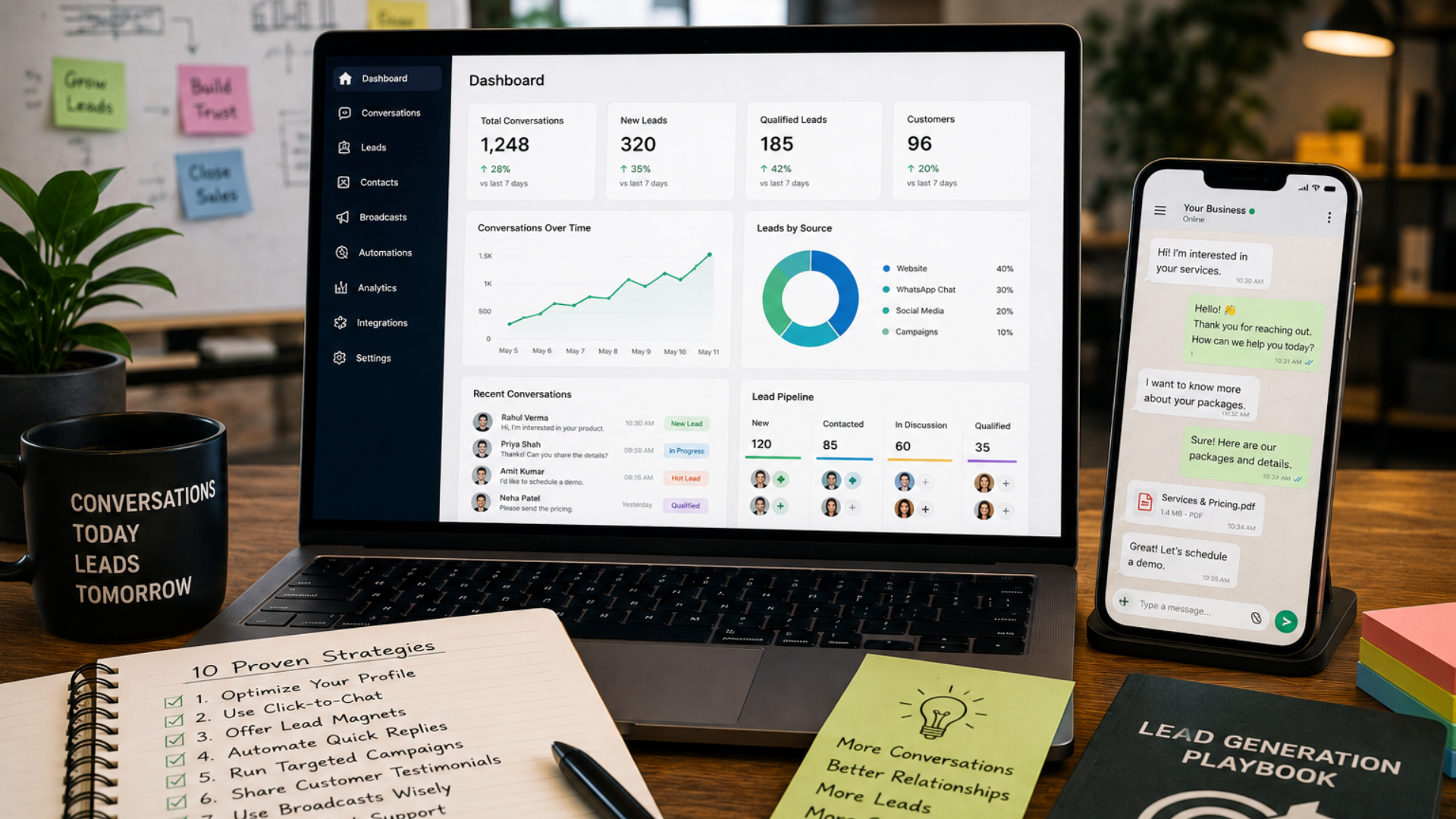
How to Get More Leads from WhatsApp Business: 10 Proven Strategies That Work

How to Get More Leads from WhatsApp Business

Over the last few years, the way customers interact with businesses has changed dramatically. People no longer want to fill out lengthy enquiry forms, wait hours for email responses, or spend time navigating complicated websites just to ask a simple question. Instead, they prefer instant, convenient communication through platforms they already use every day. Among those platforms, WhatsApp has emerged as one of the most powerful channels for connecting businesses with potential customers.

With billions of active users worldwide, WhatsApp has evolved far beyond being a personal messaging application. Today, businesses across industries, from retail and healthcare to education, real estate, hospitality, and professional services, use WhatsApp Business to answer customer questions, provide product information, schedule appointments, and build lasting relationships. Customers appreciate its familiarity, speed, and ease of use, making it one of the most effective communication channels available.

However, simply having a WhatsApp Business account doesn’t automatically generate more leads. Many businesses proudly display a WhatsApp button on their website or social media pages, only to discover that conversations remain limited or fail to convert into actual sales. In many cases, the problem isn’t attracting potential customers, it’s how those conversations are managed after they begin.

Slow response times, inconsistent follow ups, missed enquiries, and disorganized conversations can all reduce the effectiveness of WhatsApp as a lead generation tool. At the same time, businesses that use WhatsApp strategically often experience higher engagement, stronger customer relationships, and significantly better conversion rates.

The difference lies in understanding that WhatsApp isn’t simply another messaging app. When used correctly, it becomes an extension of your sales and customer engagement strategy. Every conversation presents an opportunity to build trust, answer questions, understand customer needs, and guide prospects toward making a confident buying decision.

Whether you’re a small business looking to generate your first online enquiries or an established company handling hundreds of customer conversations every day, adopting the right approach can make a noticeable difference. In this blog, we’ll explore ten proven strategies that successful businesses use to generate more qualified leads through WhatsApp Business while creating a better experience for every customer who reaches out.

1. Make It Easy for Customers to Start a Conversation

Every lead begins with a simple action: a customer deciding to contact your business. While this may seem obvious, many businesses unintentionally create unnecessary barriers that prevent potential customers from taking that first step.

Imagine visiting a company’s website after seeing one of their advertisements. You’re interested in learning more about their product, but instead of finding a visible WhatsApp button, you’re asked to fill out a lengthy contact form requesting your name, email address, phone number, company information, and several other details. Many visitors simply abandon the page because contacting the business feels like too much effort.

Now compare that experience with another business where a clearly visible “Chat with us on WhatsApp” button appears on every page. One tap instantly opens a conversation, allowing the customer to ask questions without leaving the app they already use daily. The difference may seem small, but it can have a significant impact on lead generation.

Successful businesses remove as much friction as possible from the customer journey. They make WhatsApp accessible wherever potential customers interact with their brand.

Some of the most effective places to promote your WhatsApp Business account include:

  • Your website’s homepage and service pages
  • Google Business Profile
  • Facebook and Instagram profiles
  • Click-to-WhatsApp advertisements
  • QR codes on brochures, packaging, or business cards
  • Email signatures
  • Product catalogues
  • Digital invoices and receipts

For example, a real estate agency running Facebook advertisements can direct interested buyers straight to WhatsApp instead of sending them to a generic landing page. A customer browsing apartments can immediately ask about pricing, availability, or schedule a site visit without completing multiple forms. This shorter journey often leads to higher enquiry rates because customers receive answers while their interest is still fresh.

Similarly, restaurants increasingly place WhatsApp QR codes on takeaway packaging, encouraging satisfied customers to place repeat orders or ask questions directly. Clinics include WhatsApp booking links on appointment reminder emails, making it easier for patients to reschedule visits when necessary.

The easier you make it for customers to reach your business, the more conversations you’ll naturally create. And every conversation represents a potential lead waiting to be nurtured.

However, starting the conversation is only the beginning. The real challenge begins the moment a customer sends that first message.

2. Respond While Customer Interest Is at Its Highest

Timing plays a far greater role in lead generation than many businesses realize.

When someone sends your business a message on WhatsApp, they’re actively looking for information. They may be comparing multiple suppliers, researching different products, or trying to make a purchasing decision within the next few minutes. Their interest is at its highest precisely when they choose to contact you.

Unfortunately, many businesses unintentionally allow that momentum to disappear.

Perhaps the enquiry arrives outside business hours. Maybe the salesperson is busy attending to another customer. Sometimes messages remain unread because they’re buried beneath dozens of personal conversations on the same phone. Whatever the reason, delayed responses often result in lost opportunities.

Consider someone searching for a travel package. They message three different travel agencies asking about holiday availability and pricing. The first agency responds within two minutes with helpful information and offers to answer additional questions. The second replies three hours later, while the third doesn’t respond until the following day.

Which agency is most likely to secure the booking? In many cases, customers choose the business that responds first, not necessarily because it offers the lowest price, but because it demonstrates reliability, professionalism, and a genuine willingness to help.

This doesn’t mean every response needs to be written manually within seconds. Modern businesses increasingly use automation to acknowledge enquiries immediately, reassure customers that their message has been received, and provide helpful information while a team member prepares a personalized response.

A simple welcome message can achieve several objectives at once:

  • Confirm that the enquiry has been received.
  • Set expectations regarding response times.
  • Share useful resources such as product catalogues or FAQs.
  • Keep the customer engaged while they wait.

Quick responses also create a positive first impression. Customers naturally associate responsiveness with professionalism. If a business communicates efficiently before a sale, customers often assume they’ll receive the same level of service afterward.

Lead generation isn’t only about attracting new conversations. It’s about making sure those conversations don’t lose momentum before they’ve had the chance to develop into meaningful business opportunities.

3. Ask the Right Questions to Identify Qualified Leads

Not every person who messages your business is ready to buy immediately. Some are researching options, others are comparing prices, while a few may simply be looking for general information. Treating every enquiry exactly the same often leads to wasted time and missed opportunities.

Successful businesses understand the importance of qualifying leads early in the conversation.

Instead of asking vague questions like “How can we help you?”, they guide customers through a conversation that helps uncover their specific needs.

For example, a digital marketing agency might ask:

  • Which service are you interested in?
  • What type of business do you operate?
  • Are you looking for a one-time project or ongoing support?
  • When would you like to get started?

Similarly, a healthcare clinic could ask about the preferred appointment date, the type of consultation required, or whether the patient has visited before. These questions help the business understand the enquiry while making it easier to recommend the right solution.

This approach benefits both sides. Customers receive more relevant information, while sales teams spend less time handling enquiries that aren’t a good fit.

As the number of conversations grows, asking the same qualifying questions manually can become repetitive. This is where structured conversation flows and AI-powered chat automation become valuable. They can collect essential information consistently, ensuring every lead is organized before reaching the sales team.

The result is a smoother customer experience, better lead qualification, and a more efficient sales process.

4. Keep Every Lead Organized From the Very First Message

Generating more leads is only valuable if your business can manage them effectively. Unfortunately, this is where many businesses begin to struggle. As enquiries increase, conversations become scattered, important customer information gets buried beneath newer messages, and sales teams spend more time searching for chats than actually engaging with potential customers.

In the early days of a business, managing leads through a single WhatsApp Business account might seem manageable. A handful of conversations each day can easily be tracked, and remembering customer details rarely feels difficult. As the business grows, however, the volume of enquiries grows with it. What once felt organized quickly becomes overwhelming.

Imagine a home interior design company receiving thirty to forty WhatsApp enquiries every day. Some customers are requesting quotations, others are asking about project timelines, while existing clients are following up on ongoing work. By the end of the week, hundreds of messages have accumulated across multiple chats. A customer who requested a quotation three days ago gets pushed further down the conversation list as newer enquiries continue to arrive.

Without a structured way to organize leads, businesses often experience common problems:

  • Conversations get lost beneath newer messages.
  • Different team members unknowingly contact the same customer.
  • Important follow-ups are forgotten.
  • Sales teams have no visibility into the status of each enquiry.
  • Customer information remains trapped inside individual conversations.

Successful businesses solve this by treating every WhatsApp conversation as a lead rather than simply another chat.

Instead of relying on memory, they categorize enquiries according to where each customer is in the buying journey. A new enquiry, for example, may be marked as a fresh lead, while another customer requesting pricing could move into a quotation stage. Once discussions progress further, the lead can be updated to negotiation, proposal sent, or closed successfully.

This structured approach allows sales teams to understand exactly where every opportunity stands without reopening dozens of conversations.

It also provides valuable visibility for managers. Rather than asking individual sales representatives for updates, they can instantly see how many new enquiries have arrived, how many quotations are pending, which deals require follow-up, and where customers are dropping off during the sales process.

The objective isn’t simply to organize conversations. It’s to organize opportunities. Businesses that consistently convert more leads understand that every conversation has potential value. Treating WhatsApp as a lead management channel instead of just a messaging application ensures that opportunities remain visible until they reach a clear outcome.

5. Follow Up Consistently Without Sounding Pushy

One of the biggest misconceptions in sales is believing that a customer who doesn’t reply is no longer interested. The reality is often very different.

People get busy with work, meetings, family responsibilities, and countless daily distractions. They may genuinely intend to respond but simply forget. Others continue researching multiple providers before making a decision, while some postpone purchases because the timing isn’t right.

This is why successful businesses never assume silence means rejection. Instead, they build thoughtful follow-up strategies that keep conversations active without making customers feel pressured.

Imagine someone requesting pricing for office furniture. They receive the quotation but don’t respond immediately. A week later, another business sends a friendly follow-up asking whether they have any questions or require assistance choosing the right products. Rather than aggressively pushing for a sale, the message simply reopens the conversation.

That small reminder often becomes the difference between losing a lead and winning a customer. Effective follow-ups focus on providing value rather than repeating the same sales message. Depending on your industry, you might share additional product information, answer frequently asked questions, highlight customer success stories, notify prospects about limited-time offers, or simply check whether they need further assistance.

The timing of these follow ups is equally important. Sending multiple messages within a few hours can appear intrusive, while waiting several weeks may allow customers to move on to competitors. Finding the right balance helps businesses remain helpful without becoming overwhelming.

As lead volumes increase, manually remembering when each customer should receive a follow-up becomes almost impossible. Businesses handling dozens or hundreds of conversations every week often rely on structured workflows and automated reminders to ensure every lead receives timely attention.

Consistency plays a significant role in improving conversion rates. Many sales opportunities aren’t lost because businesses lack quality products or services. They’re lost because nobody reached out again after the initial conversation.

Following up isn’t about convincing people to buy. It’s about making sure interested customers aren’t forgotten.

6. Make Sure Every Enquiry Reaches the Right Person

As businesses expand, customer conversations naturally become more specialized.

Some enquiries relate to sales, while others involve technical support, billing questions, appointment scheduling, or existing customer service. Expecting one employee to manage every conversation eventually creates delays, confusion, and inconsistent customer experiences.

Imagine an educational institution receiving enquiries through WhatsApp. One parent wants information about admissions. Another student needs technical assistance accessing an online course. Someone else wants to discuss fee payments.

If all these messages arrive on a single phone handled by one person, response times inevitably increase. That employee constantly switches between different types of enquiries, often forwarding conversations manually to colleagues or asking customers to contact another department.

Successful businesses avoid this by ensuring conversations reach the people best equipped to handle them.

  • Sales enquiries go directly to sales representatives.
  • Support requests reach customer service teams.
  • Finance-related questions are handled by the accounts department.
  • Appointment requests are assigned to scheduling teams.

This structured distribution reduces response times while improving the overall customer experience. Customers no longer need to repeat their questions multiple times because conversations begin with the appropriate department from the start.

As businesses continue growing, automatic conversation assignment becomes increasingly valuable. Instead of relying on manual transfers, enquiries can be distributed according to predefined rules, employee availability, department, language preferences, or workload.

Some organizations also use round-robin assignment to distribute new leads evenly among sales representatives, ensuring opportunities are shared fairly while preventing individual team members from becoming overloaded.

Efficient lead generation isn’t simply about attracting more conversations. It’s about ensuring every conversation reaches the right person at the right time.

7. Continue the Conversation, No Matter Where It Starts

Today’s customers rarely interact with businesses through a single channel. A customer may discover your brand through an Instagram advertisement, browse your website for more information, send an enquiry through WhatsApp, receive a follow-up email, and eventually complete the purchase after speaking with your sales team over a phone call.

  • From the customer’s perspective, this is one continuous conversation.
  • From the business’s perspective, however, these interactions often become fragmented across multiple platforms.
  • Marketing teams see social media messages.
  • Sales teams manage WhatsApp conversations.
  • Customer support responds through email.

Without visibility across channels, every interaction begins from scratch. We’ve all experienced this frustration as customers ourselves.

You explain your requirements through one channel, only to be asked exactly the same questions when speaking to another representative. Previous conversations aren’t available, customer history isn’t visible, and valuable context is lost every time communication shifts from one platform to another.

Successful businesses understand that customers don’t think in channels. They think in conversations. Regardless of whether someone contacts the business through WhatsApp, Instagram, Facebook Messenger, website live chat, or email, they expect the company to remember previous interactions and continue the discussion naturally.

Maintaining this continuity builds trust. Customers appreciate not having to repeat information, while employees gain a complete understanding of every interaction before responding. Sales representatives can see previous support requests, customer service teams understand earlier purchasing decisions, and managers gain a clearer picture of the overall customer journey.

As businesses grow, providing this seamless experience becomes increasingly important. Customers compare experiences just as much as they compare products and prices. Businesses that deliver consistent communication across every touchpoint often create stronger relationships than competitors who treat every channel independently.

Generating leads is only the first step. Creating connected customer experiences is what transforms those leads into loyal, long term customers.

8. Re engage Leads Who Didn’t Convert the First Time

One of the biggest mistakes businesses make is assuming that every unanswered WhatsApp conversation is a lost opportunity. In reality, many potential customers don’t disappear because they aren’t interested. They simply get distracted, postpone their decision, compare different providers, or decide to revisit the purchase at a later date.

Think about your own buying behavior. You may enquire about a new laptop, request pricing for office furniture, or ask a travel agency about holiday packages. Even if you’re genuinely interested, it doesn’t always mean you’ll make a decision on the same day. Work commitments, budget discussions, or simply needing more time to think often delay the purchase.

The same applies to your customers. Businesses that consistently generate more sales understand that lead generation doesn’t stop after the first conversation. Instead, they build strategies to reconnect with prospects in a way that feels relevant and helpful rather than repetitive.

For example, imagine a customer who requested information about your digital marketing services but never moved forward. Instead of sending another message asking, “Are you still interested?”, you could share a recent case study demonstrating how one of your clients increased website traffic, or provide a short guide explaining how businesses can improve their online presence. The conversation becomes valuable again because you’re offering useful information instead of simply asking for a response.

Similarly, an interior design company could share photos of recently completed projects, while a travel agency might notify previous enquiries about newly launched holiday packages or seasonal discounts. A healthcare clinic could remind patients about annual health check-up packages, and an educational institution could inform prospective students about upcoming admission deadlines.

The goal is to remain visible without becoming intrusive. Timing also matters. Contacting a customer every day quickly becomes annoying, while reaching out every few months may cause them to forget your business altogether. Creating a structured follow-up schedule allows businesses to stay connected while respecting the customer’s decision-making process.

Another important factor is segmentation. Not every lead should receive the same message. Someone interested in website development shouldn’t receive updates about mobile application services. A customer looking for residential real estate has different needs than someone searching for commercial property. Segmenting leads according to their interests allows businesses to send communication that feels more personal and relevant.

Modern businesses increasingly use automation to schedule these follow-ups based on customer behaviour, ensuring no valuable opportunity is forgotten while maintaining a personalized experience. 

Many businesses invest heavily in generating new leads while overlooking the prospects already sitting in their existing conversations. Sometimes, your next customer isn’t someone new. They’re someone who already messaged you a few weeks ago.

9. Measure What’s Working and Continuously Improve

Generating leads is important, but generating better leads is even more valuable. Many businesses celebrate receiving hundreds of WhatsApp messages every month, yet they struggle to answer a much more important question:

How many of those conversations actually became customers?

Without measuring performance, it’s impossible to know whether your lead generation strategy is improving or simply creating more activity.

Successful businesses don’t rely on assumptions. They regularly evaluate how effectively their customer communication contributes to business growth. Instead of focusing only on the number of incoming enquiries, they analyze the entire customer journey from the first message through to conversion.

Some of the most valuable metrics include:

First Response Time: How quickly does your team respond to new enquiries? A shorter response time often leads to higher engagement because customers receive assistance while their interest is still high.

Lead Conversion Rate: How many WhatsApp conversations eventually become paying customers? Understanding this percentage helps businesses evaluate the quality of both their marketing efforts and their sales conversations.

Source of Enquiries: Where are your best leads coming from? Are customers finding you through Google searches, Facebook advertisements, Instagram campaigns, QR codes, or referrals? Knowing the answer allows businesses to invest more confidently in their highest-performing marketing channels.

Team Performance: If multiple sales representatives handle WhatsApp enquiries, comparing response times, conversion rates, and customer satisfaction can highlight opportunities for coaching and process improvements.

Customer Journey:

  • At what stage are leads dropping off?
  • Do customers lose interest after requesting pricing?
  • Do they stop responding after receiving quotations?
  • Or are follow-ups not happening consistently?

These insights reveal where improvements can have the greatest impact.

Data transforms decision-making. Instead of guessing why sales are slowing down, businesses can identify the exact stage where customers disengage and take meaningful action to improve results. Over time, these small improvements compound.

A slightly faster response time, a stronger follow-up process, or better lead qualification may each improve conversion rates by only a few percentage points. Combined, however, they can significantly increase revenue without spending additional money on advertising.

The businesses that generate the most leads aren’t always the ones attracting the largest audiences. They’re often the ones learning from every conversation and continuously improving the way they communicate.

10. Focus on Building Relationships, Not Just Collecting Leads

Every strategy discussed so far ultimately leads to one important principle. People don’t want to feel like another sales opportunity. They want to feel understood.

Lead generation is often viewed as a numbers game, with businesses focusing on how many enquiries they receive each day or how many conversations begin through WhatsApp. While those numbers are certainly important, they don’t tell the whole story.

A successful business doesn’t simply collect leads. It builds relationships. Customers remember businesses that communicate professionally, respond quickly, remember previous conversations, and provide helpful guidance without applying unnecessary pressure. They appreciate businesses that understand their needs instead of immediately trying to make a sale.

Consider two companies selling similar products.

The first responds with generic answers, asks customers to repeat information every time they make contact, and disappears after sending a quotation.

The second remembers previous conversations, follows up thoughtfully, provides useful recommendations, and continues offering support even after the purchase has been completed.

  • Which company is more likely to receive repeat business?
  • Which company is more likely to be recommended to friends and colleagues?

In most cases, the answer is obvious.

Trust is built through consistent communication. Every interaction shapes how customers perceive your business, whether they’re making their first enquiry or returning months later for another purchase. This is why businesses should think beyond individual sales.

  • A satisfied customer may become a repeat customer.
  • A repeat customer may become a long-term client.
  • A long-term client may become one of your strongest sources of referrals.

When communication is managed consistently, every conversation contributes to a stronger relationship rather than simply another transaction.

Ultimately, WhatsApp isn’t just a platform for answering questions. It’s a platform for creating experiences that encourage customers to stay connected with your business long after the initial enquiry.

Wrapping It Up

WhatsApp Business has transformed the way businesses communicate with customers. What began as a simple messaging application has become one of the most effective channels for generating enquiries, answering questions, nurturing relationships, and converting prospects into loyal customers.

However, success doesn’t come from using WhatsApp alone. It comes from how you use it. Businesses that consistently generate more leads make it incredibly easy for customers to start conversations. 

They respond quickly while interest is at its highest, qualify enquiries efficiently, organize every lead carefully, follow up consistently, route conversations to the right people, maintain communication across multiple channels, reconnect with inactive prospects, measure performance, and focus on building long-term customer relationships rather than chasing one-time sales.

Individually, each of these strategies delivers meaningful improvements. Together, they create a customer communication system that supports sustainable business growth.

As your business expands, managing these conversations manually becomes increasingly difficult. Multiple team members, growing enquiry volumes, different communication channels, and repetitive administrative tasks can quickly slow down even the most dedicated sales teams.

This is where a customer communication platform can make a significant difference.

ihakimi helps businesses bring their entire customer communication process into one place. From AI-powered chat automation and WhatsApp Flows to shared team inboxes, lead management, CRM, omnichannel messaging, broadcasts, analytics, and workflow automation, it enables businesses to manage every stage of the customer journey more efficiently.

Rather than switching between disconnected tools or worrying about missed opportunities, teams can focus on what matters most, building meaningful conversations that turn interested prospects into loyal customers.

Because at the end of the day, generating more leads isn’t just about receiving more messages. It’s about creating better conversations that inspire customers to choose your business with confidence.

How to Get More Leads from WhatsApp Business

Over the last few years, the way customers interact with businesses has changed dramatically. People no longer want to fill out lengthy enquiry forms, wait hours for email responses, or spend time navigating complicated websites just to ask a simple question. Instead, they prefer instant, convenient communication through platforms they already use every day. Among those platforms, WhatsApp has emerged as one of the most powerful channels for connecting businesses with potential customers.

With billions of active users worldwide, WhatsApp has evolved far beyond being a personal messaging application. Today, businesses across industries, from retail and healthcare to education, real estate, hospitality, and professional services, use WhatsApp Business to answer customer questions, provide product information, schedule appointments, and build lasting relationships. Customers appreciate its familiarity, speed, and ease of use, making it one of the most effective communication channels available.

However, simply having a WhatsApp Business account doesn’t automatically generate more leads. Many businesses proudly display a WhatsApp button on their website or social media pages, only to discover that conversations remain limited or fail to convert into actual sales. In many cases, the problem isn’t attracting potential customers, it’s how those conversations are managed after they begin.

Slow response times, inconsistent follow ups, missed enquiries, and disorganized conversations can all reduce the effectiveness of WhatsApp as a lead generation tool. At the same time, businesses that use WhatsApp strategically often experience higher engagement, stronger customer relationships, and significantly better conversion rates.

The difference lies in understanding that WhatsApp isn’t simply another messaging app. When used correctly, it becomes an extension of your sales and customer engagement strategy. Every conversation presents an opportunity to build trust, answer questions, understand customer needs, and guide prospects toward making a confident buying decision.

Whether you’re a small business looking to generate your first online enquiries or an established company handling hundreds of customer conversations every day, adopting the right approach can make a noticeable difference. In this blog, we’ll explore ten proven strategies that successful businesses use to generate more qualified leads through WhatsApp Business while creating a better experience for every customer who reaches out.

1. Make It Easy for Customers to Start a Conversation

Every lead begins with a simple action: a customer deciding to contact your business. While this may seem obvious, many businesses unintentionally create unnecessary barriers that prevent potential customers from taking that first step.

Imagine visiting a company’s website after seeing one of their advertisements. You’re interested in learning more about their product, but instead of finding a visible WhatsApp button, you’re asked to fill out a lengthy contact form requesting your name, email address, phone number, company information, and several other details. Many visitors simply abandon the page because contacting the business feels like too much effort.

Now compare that experience with another business where a clearly visible “Chat with us on WhatsApp” button appears on every page. One tap instantly opens a conversation, allowing the customer to ask questions without leaving the app they already use daily. The difference may seem small, but it can have a significant impact on lead generation.

Successful businesses remove as much friction as possible from the customer journey. They make WhatsApp accessible wherever potential customers interact with their brand.

Some of the most effective places to promote your WhatsApp Business account include:

  • Your website’s homepage and service pages
  • Google Business Profile
  • Facebook and Instagram profiles
  • Click-to-WhatsApp advertisements
  • QR codes on brochures, packaging, or business cards
  • Email signatures
  • Product catalogues
  • Digital invoices and receipts

For example, a real estate agency running Facebook advertisements can direct interested buyers straight to WhatsApp instead of sending them to a generic landing page. A customer browsing apartments can immediately ask about pricing, availability, or schedule a site visit without completing multiple forms. This shorter journey often leads to higher enquiry rates because customers receive answers while their interest is still fresh.

Similarly, restaurants increasingly place WhatsApp QR codes on takeaway packaging, encouraging satisfied customers to place repeat orders or ask questions directly. Clinics include WhatsApp booking links on appointment reminder emails, making it easier for patients to reschedule visits when necessary.

The easier you make it for customers to reach your business, the more conversations you’ll naturally create. And every conversation represents a potential lead waiting to be nurtured.

However, starting the conversation is only the beginning. The real challenge begins the moment a customer sends that first message.

2. Respond While Customer Interest Is at Its Highest

Timing plays a far greater role in lead generation than many businesses realize.

When someone sends your business a message on WhatsApp, they’re actively looking for information. They may be comparing multiple suppliers, researching different products, or trying to make a purchasing decision within the next few minutes. Their interest is at its highest precisely when they choose to contact you.

Unfortunately, many businesses unintentionally allow that momentum to disappear.

Perhaps the enquiry arrives outside business hours. Maybe the salesperson is busy attending to another customer. Sometimes messages remain unread because they’re buried beneath dozens of personal conversations on the same phone. Whatever the reason, delayed responses often result in lost opportunities.

Consider someone searching for a travel package. They message three different travel agencies asking about holiday availability and pricing. The first agency responds within two minutes with helpful information and offers to answer additional questions. The second replies three hours later, while the third doesn’t respond until the following day.

Which agency is most likely to secure the booking? In many cases, customers choose the business that responds first, not necessarily because it offers the lowest price, but because it demonstrates reliability, professionalism, and a genuine willingness to help.

This doesn’t mean every response needs to be written manually within seconds. Modern businesses increasingly use automation to acknowledge enquiries immediately, reassure customers that their message has been received, and provide helpful information while a team member prepares a personalized response.

A simple welcome message can achieve several objectives at once:

  • Confirm that the enquiry has been received.
  • Set expectations regarding response times.
  • Share useful resources such as product catalogues or FAQs.
  • Keep the customer engaged while they wait.

Quick responses also create a positive first impression. Customers naturally associate responsiveness with professionalism. If a business communicates efficiently before a sale, customers often assume they’ll receive the same level of service afterward.

Lead generation isn’t only about attracting new conversations. It’s about making sure those conversations don’t lose momentum before they’ve had the chance to develop into meaningful business opportunities.

3. Ask the Right Questions to Identify Qualified Leads

Not every person who messages your business is ready to buy immediately. Some are researching options, others are comparing prices, while a few may simply be looking for general information. Treating every enquiry exactly the same often leads to wasted time and missed opportunities.

Successful businesses understand the importance of qualifying leads early in the conversation.

Instead of asking vague questions like “How can we help you?”, they guide customers through a conversation that helps uncover their specific needs.

For example, a digital marketing agency might ask:

  • Which service are you interested in?
  • What type of business do you operate?
  • Are you looking for a one-time project or ongoing support?
  • When would you like to get started?

Similarly, a healthcare clinic could ask about the preferred appointment date, the type of consultation required, or whether the patient has visited before. These questions help the business understand the enquiry while making it easier to recommend the right solution.

This approach benefits both sides. Customers receive more relevant information, while sales teams spend less time handling enquiries that aren’t a good fit.

As the number of conversations grows, asking the same qualifying questions manually can become repetitive. This is where structured conversation flows and AI-powered chat automation become valuable. They can collect essential information consistently, ensuring every lead is organized before reaching the sales team.

The result is a smoother customer experience, better lead qualification, and a more efficient sales process.

4. Keep Every Lead Organized From the Very First Message

Generating more leads is only valuable if your business can manage them effectively. Unfortunately, this is where many businesses begin to struggle. As enquiries increase, conversations become scattered, important customer information gets buried beneath newer messages, and sales teams spend more time searching for chats than actually engaging with potential customers.

In the early days of a business, managing leads through a single WhatsApp Business account might seem manageable. A handful of conversations each day can easily be tracked, and remembering customer details rarely feels difficult. As the business grows, however, the volume of enquiries grows with it. What once felt organized quickly becomes overwhelming.

Imagine a home interior design company receiving thirty to forty WhatsApp enquiries every day. Some customers are requesting quotations, others are asking about project timelines, while existing clients are following up on ongoing work. By the end of the week, hundreds of messages have accumulated across multiple chats. A customer who requested a quotation three days ago gets pushed further down the conversation list as newer enquiries continue to arrive.

Without a structured way to organize leads, businesses often experience common problems:

  • Conversations get lost beneath newer messages.
  • Different team members unknowingly contact the same customer.
  • Important follow-ups are forgotten.
  • Sales teams have no visibility into the status of each enquiry.
  • Customer information remains trapped inside individual conversations.

Successful businesses solve this by treating every WhatsApp conversation as a lead rather than simply another chat.

Instead of relying on memory, they categorize enquiries according to where each customer is in the buying journey. A new enquiry, for example, may be marked as a fresh lead, while another customer requesting pricing could move into a quotation stage. Once discussions progress further, the lead can be updated to negotiation, proposal sent, or closed successfully.

This structured approach allows sales teams to understand exactly where every opportunity stands without reopening dozens of conversations.

It also provides valuable visibility for managers. Rather than asking individual sales representatives for updates, they can instantly see how many new enquiries have arrived, how many quotations are pending, which deals require follow-up, and where customers are dropping off during the sales process.

The objective isn’t simply to organize conversations. It’s to organize opportunities. Businesses that consistently convert more leads understand that every conversation has potential value. Treating WhatsApp as a lead management channel instead of just a messaging application ensures that opportunities remain visible until they reach a clear outcome.

5. Follow Up Consistently Without Sounding Pushy

One of the biggest misconceptions in sales is believing that a customer who doesn’t reply is no longer interested. The reality is often very different.

People get busy with work, meetings, family responsibilities, and countless daily distractions. They may genuinely intend to respond but simply forget. Others continue researching multiple providers before making a decision, while some postpone purchases because the timing isn’t right.

This is why successful businesses never assume silence means rejection. Instead, they build thoughtful follow-up strategies that keep conversations active without making customers feel pressured.

Imagine someone requesting pricing for office furniture. They receive the quotation but don’t respond immediately. A week later, another business sends a friendly follow-up asking whether they have any questions or require assistance choosing the right products. Rather than aggressively pushing for a sale, the message simply reopens the conversation.

That small reminder often becomes the difference between losing a lead and winning a customer. Effective follow-ups focus on providing value rather than repeating the same sales message. Depending on your industry, you might share additional product information, answer frequently asked questions, highlight customer success stories, notify prospects about limited-time offers, or simply check whether they need further assistance.

The timing of these follow ups is equally important. Sending multiple messages within a few hours can appear intrusive, while waiting several weeks may allow customers to move on to competitors. Finding the right balance helps businesses remain helpful without becoming overwhelming.

As lead volumes increase, manually remembering when each customer should receive a follow-up becomes almost impossible. Businesses handling dozens or hundreds of conversations every week often rely on structured workflows and automated reminders to ensure every lead receives timely attention.

Consistency plays a significant role in improving conversion rates. Many sales opportunities aren’t lost because businesses lack quality products or services. They’re lost because nobody reached out again after the initial conversation.

Following up isn’t about convincing people to buy. It’s about making sure interested customers aren’t forgotten.

6. Make Sure Every Enquiry Reaches the Right Person

As businesses expand, customer conversations naturally become more specialized.

Some enquiries relate to sales, while others involve technical support, billing questions, appointment scheduling, or existing customer service. Expecting one employee to manage every conversation eventually creates delays, confusion, and inconsistent customer experiences.

Imagine an educational institution receiving enquiries through WhatsApp. One parent wants information about admissions. Another student needs technical assistance accessing an online course. Someone else wants to discuss fee payments.

If all these messages arrive on a single phone handled by one person, response times inevitably increase. That employee constantly switches between different types of enquiries, often forwarding conversations manually to colleagues or asking customers to contact another department.

Successful businesses avoid this by ensuring conversations reach the people best equipped to handle them.

  • Sales enquiries go directly to sales representatives.
  • Support requests reach customer service teams.
  • Finance-related questions are handled by the accounts department.
  • Appointment requests are assigned to scheduling teams.

This structured distribution reduces response times while improving the overall customer experience. Customers no longer need to repeat their questions multiple times because conversations begin with the appropriate department from the start.

As businesses continue growing, automatic conversation assignment becomes increasingly valuable. Instead of relying on manual transfers, enquiries can be distributed according to predefined rules, employee availability, department, language preferences, or workload.

Some organizations also use round-robin assignment to distribute new leads evenly among sales representatives, ensuring opportunities are shared fairly while preventing individual team members from becoming overloaded.

Efficient lead generation isn’t simply about attracting more conversations. It’s about ensuring every conversation reaches the right person at the right time.

7. Continue the Conversation, No Matter Where It Starts

Today’s customers rarely interact with businesses through a single channel. A customer may discover your brand through an Instagram advertisement, browse your website for more information, send an enquiry through WhatsApp, receive a follow-up email, and eventually complete the purchase after speaking with your sales team over a phone call.

  • From the customer’s perspective, this is one continuous conversation.
  • From the business’s perspective, however, these interactions often become fragmented across multiple platforms.
  • Marketing teams see social media messages.
  • Sales teams manage WhatsApp conversations.
  • Customer support responds through email.

Without visibility across channels, every interaction begins from scratch. We’ve all experienced this frustration as customers ourselves.

You explain your requirements through one channel, only to be asked exactly the same questions when speaking to another representative. Previous conversations aren’t available, customer history isn’t visible, and valuable context is lost every time communication shifts from one platform to another.

Successful businesses understand that customers don’t think in channels. They think in conversations. Regardless of whether someone contacts the business through WhatsApp, Instagram, Facebook Messenger, website live chat, or email, they expect the company to remember previous interactions and continue the discussion naturally.

Maintaining this continuity builds trust. Customers appreciate not having to repeat information, while employees gain a complete understanding of every interaction before responding. Sales representatives can see previous support requests, customer service teams understand earlier purchasing decisions, and managers gain a clearer picture of the overall customer journey.

As businesses grow, providing this seamless experience becomes increasingly important. Customers compare experiences just as much as they compare products and prices. Businesses that deliver consistent communication across every touchpoint often create stronger relationships than competitors who treat every channel independently.

Generating leads is only the first step. Creating connected customer experiences is what transforms those leads into loyal, long term customers.

8. Re engage Leads Who Didn’t Convert the First Time

One of the biggest mistakes businesses make is assuming that every unanswered WhatsApp conversation is a lost opportunity. In reality, many potential customers don’t disappear because they aren’t interested. They simply get distracted, postpone their decision, compare different providers, or decide to revisit the purchase at a later date.

Think about your own buying behavior. You may enquire about a new laptop, request pricing for office furniture, or ask a travel agency about holiday packages. Even if you’re genuinely interested, it doesn’t always mean you’ll make a decision on the same day. Work commitments, budget discussions, or simply needing more time to think often delay the purchase.

The same applies to your customers. Businesses that consistently generate more sales understand that lead generation doesn’t stop after the first conversation. Instead, they build strategies to reconnect with prospects in a way that feels relevant and helpful rather than repetitive.

For example, imagine a customer who requested information about your digital marketing services but never moved forward. Instead of sending another message asking, “Are you still interested?”, you could share a recent case study demonstrating how one of your clients increased website traffic, or provide a short guide explaining how businesses can improve their online presence. The conversation becomes valuable again because you’re offering useful information instead of simply asking for a response.

Similarly, an interior design company could share photos of recently completed projects, while a travel agency might notify previous enquiries about newly launched holiday packages or seasonal discounts. A healthcare clinic could remind patients about annual health check-up packages, and an educational institution could inform prospective students about upcoming admission deadlines.

The goal is to remain visible without becoming intrusive. Timing also matters. Contacting a customer every day quickly becomes annoying, while reaching out every few months may cause them to forget your business altogether. Creating a structured follow-up schedule allows businesses to stay connected while respecting the customer’s decision-making process.

Another important factor is segmentation. Not every lead should receive the same message. Someone interested in website development shouldn’t receive updates about mobile application services. A customer looking for residential real estate has different needs than someone searching for commercial property. Segmenting leads according to their interests allows businesses to send communication that feels more personal and relevant.

Modern businesses increasingly use automation to schedule these follow-ups based on customer behaviour, ensuring no valuable opportunity is forgotten while maintaining a personalized experience. 

Many businesses invest heavily in generating new leads while overlooking the prospects already sitting in their existing conversations. Sometimes, your next customer isn’t someone new. They’re someone who already messaged you a few weeks ago.

9. Measure What’s Working and Continuously Improve

Generating leads is important, but generating better leads is even more valuable. Many businesses celebrate receiving hundreds of WhatsApp messages every month, yet they struggle to answer a much more important question:

How many of those conversations actually became customers?

Without measuring performance, it’s impossible to know whether your lead generation strategy is improving or simply creating more activity.

Successful businesses don’t rely on assumptions. They regularly evaluate how effectively their customer communication contributes to business growth. Instead of focusing only on the number of incoming enquiries, they analyze the entire customer journey from the first message through to conversion.

Some of the most valuable metrics include:

First Response Time: How quickly does your team respond to new enquiries? A shorter response time often leads to higher engagement because customers receive assistance while their interest is still high.

Lead Conversion Rate: How many WhatsApp conversations eventually become paying customers? Understanding this percentage helps businesses evaluate the quality of both their marketing efforts and their sales conversations.

Source of Enquiries: Where are your best leads coming from? Are customers finding you through Google searches, Facebook advertisements, Instagram campaigns, QR codes, or referrals? Knowing the answer allows businesses to invest more confidently in their highest-performing marketing channels.

Team Performance: If multiple sales representatives handle WhatsApp enquiries, comparing response times, conversion rates, and customer satisfaction can highlight opportunities for coaching and process improvements.

Customer Journey:

  • At what stage are leads dropping off?
  • Do customers lose interest after requesting pricing?
  • Do they stop responding after receiving quotations?
  • Or are follow-ups not happening consistently?

These insights reveal where improvements can have the greatest impact.

Data transforms decision-making. Instead of guessing why sales are slowing down, businesses can identify the exact stage where customers disengage and take meaningful action to improve results. Over time, these small improvements compound.

A slightly faster response time, a stronger follow-up process, or better lead qualification may each improve conversion rates by only a few percentage points. Combined, however, they can significantly increase revenue without spending additional money on advertising.

The businesses that generate the most leads aren’t always the ones attracting the largest audiences. They’re often the ones learning from every conversation and continuously improving the way they communicate.

10. Focus on Building Relationships, Not Just Collecting Leads

Every strategy discussed so far ultimately leads to one important principle. People don’t want to feel like another sales opportunity. They want to feel understood.

Lead generation is often viewed as a numbers game, with businesses focusing on how many enquiries they receive each day or how many conversations begin through WhatsApp. While those numbers are certainly important, they don’t tell the whole story.

A successful business doesn’t simply collect leads. It builds relationships. Customers remember businesses that communicate professionally, respond quickly, remember previous conversations, and provide helpful guidance without applying unnecessary pressure. They appreciate businesses that understand their needs instead of immediately trying to make a sale.

Consider two companies selling similar products.

The first responds with generic answers, asks customers to repeat information every time they make contact, and disappears after sending a quotation.

The second remembers previous conversations, follows up thoughtfully, provides useful recommendations, and continues offering support even after the purchase has been completed.

  • Which company is more likely to receive repeat business?
  • Which company is more likely to be recommended to friends and colleagues?

In most cases, the answer is obvious.

Trust is built through consistent communication. Every interaction shapes how customers perceive your business, whether they’re making their first enquiry or returning months later for another purchase. This is why businesses should think beyond individual sales.

  • A satisfied customer may become a repeat customer.
  • A repeat customer may become a long-term client.
  • A long-term client may become one of your strongest sources of referrals.

When communication is managed consistently, every conversation contributes to a stronger relationship rather than simply another transaction.

Ultimately, WhatsApp isn’t just a platform for answering questions. It’s a platform for creating experiences that encourage customers to stay connected with your business long after the initial enquiry.

Wrapping It Up

WhatsApp Business has transformed the way businesses communicate with customers. What began as a simple messaging application has become one of the most effective channels for generating enquiries, answering questions, nurturing relationships, and converting prospects into loyal customers.

However, success doesn’t come from using WhatsApp alone. It comes from how you use it. Businesses that consistently generate more leads make it incredibly easy for customers to start conversations. 

They respond quickly while interest is at its highest, qualify enquiries efficiently, organize every lead carefully, follow up consistently, route conversations to the right people, maintain communication across multiple channels, reconnect with inactive prospects, measure performance, and focus on building long-term customer relationships rather than chasing one-time sales.

Individually, each of these strategies delivers meaningful improvements. Together, they create a customer communication system that supports sustainable business growth.

As your business expands, managing these conversations manually becomes increasingly difficult. Multiple team members, growing enquiry volumes, different communication channels, and repetitive administrative tasks can quickly slow down even the most dedicated sales teams.

This is where a customer communication platform can make a significant difference.

ihakimi helps businesses bring their entire customer communication process into one place. From AI-powered chat automation and WhatsApp Flows to shared team inboxes, lead management, CRM, omnichannel messaging, broadcasts, analytics, and workflow automation, it enables businesses to manage every stage of the customer journey more efficiently.

Rather than switching between disconnected tools or worrying about missed opportunities, teams can focus on what matters most, building meaningful conversations that turn interested prospects into loyal customers.

Because at the end of the day, generating more leads isn’t just about receiving more messages. It’s about creating better conversations that inspire customers to choose your business with confidence.

Scroll to Top