
WhatsApp Chatbot vs AI Agent: What’s the Difference and Which One Do You Need?
WhatsApp has become much more than a place where customers send a quick “Hi” to a business. For many companies, it is now where customers ask about products, request quotations, book appointments, check order updates, raise support questions, and sometimes complete almost their entire buying journey. As the number of conversations grows, however, manually answering every message becomes difficult, which is why businesses increasingly look towards chatbots and AI agents to handle part of that communication.
This is also where the terminology starts getting confusing. WhatsApp chatbots and WhatsApp AI agents are often spoken about as though they are the same thing. Both can respond automatically, both can operate outside normal business hours, and both can reduce repetitive work for customer-facing teams. What happens behind those responses, however, can be very different.
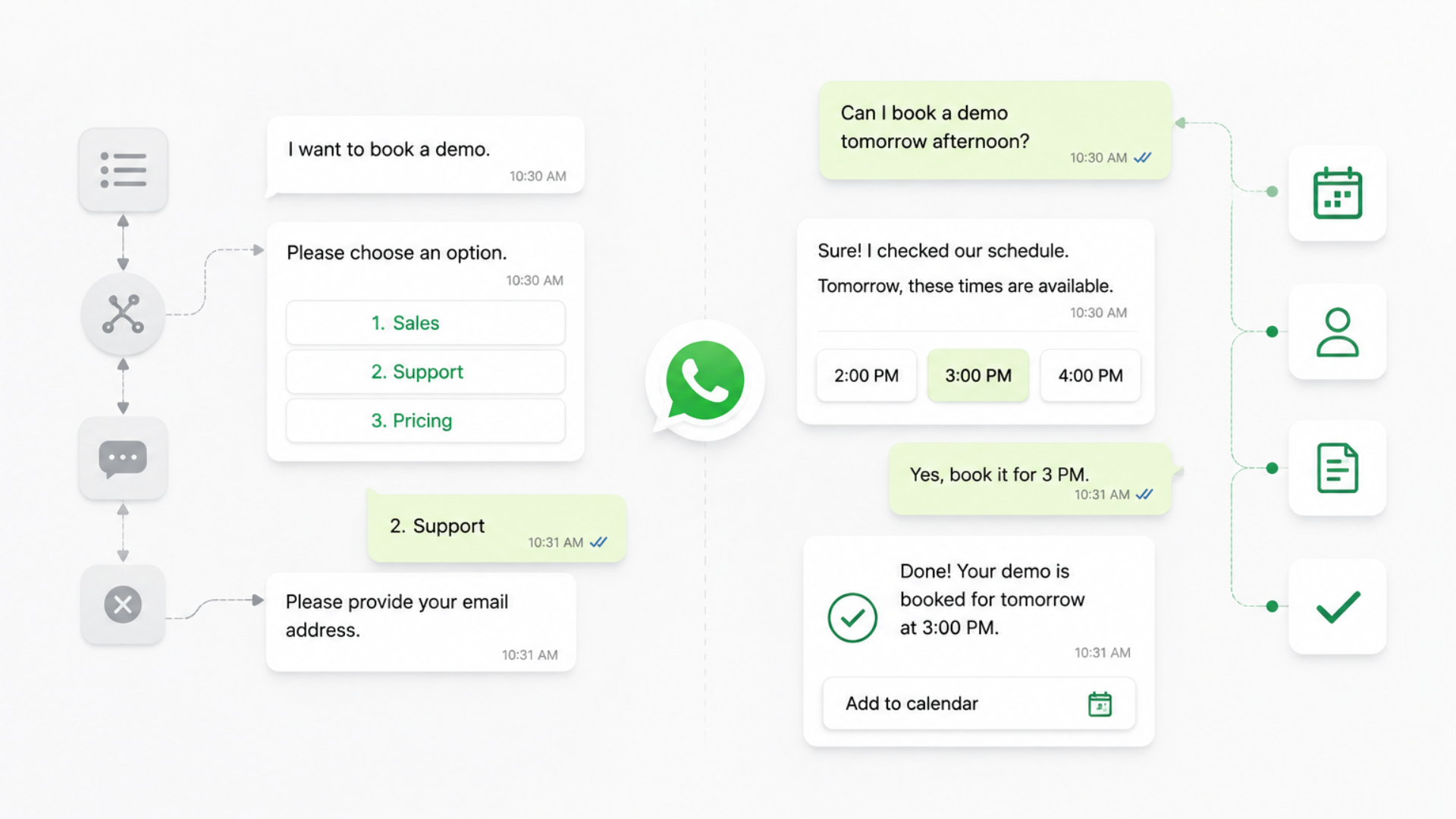
A traditional chatbot usually works through predefined rules and conversation flows. It knows what to do because the business has already designed the path a customer should follow. An AI agent takes a more flexible approach. It can understand what a customer is asking in natural language, use the business information it has been given, and generate an appropriate response without requiring every possible conversation to be mapped beforehand.
The important question for a business, therefore, isn’t whether chatbots are better than AI agents or whether AI will make traditional chatbot flows irrelevant. The better question is: which approach makes sense for the type of customer conversation you are trying to handle?
In many cases, the answer may actually be both. With ihakimi, businesses can build structured WhatsApp chatbot journeys as well as AI-powered agents, allowing automation to match the conversation instead of forcing every customer through the same experience. To understand why that matters, we first need to look at how the two technologies actually work.
1. What Is a WhatsApp Chatbot?
A WhatsApp chatbot is an automated system designed to communicate with customers through WhatsApp based on predefined rules, triggers, questions, and conversation paths. Instead of requiring an employee to manually answer every incoming message, the chatbot can guide customers through common interactions automatically.
Consider a real estate company receiving a new WhatsApp enquiry. The chatbot could greet the customer and ask whether they are interested in buying, renting, or selling a property. If the customer selects “Buy,” the next step could ask about the preferred property type. The following question might ask about location, followed by budget and other requirements. Once the necessary information has been collected, the conversation can be transferred to the appropriate sales representative.
The important point is that the business has already decided how this conversation should progress. If a customer chooses option A, the chatbot follows one path; if they choose option B, it follows another. Conditions, triggers, and actions determine what happens at each stage.
This structured approach is extremely useful for predictable customer journeys. Appointment bookings, lead qualification, frequently asked questions, feedback collection, order enquiries, registrations, and basic support processes can often be handled efficiently through a well-designed chatbot.
ihakimi’s No-Code Bot Builder allows businesses to create these kinds of conversational workflows visually rather than programming them from scratch. Teams can create different paths, add conditions, trigger actions, collect customer information, and determine when a conversation should move to another flow or a human team member. This makes chatbot automation practical even for businesses without an in-house development team.
The advantage of this approach is control. A business knows exactly what questions will be asked, which options customers can select, and what action should happen next. For processes where consistency is important, that level of structure can be extremely valuable.
2. What Is a WhatsApp AI Agent?
A WhatsApp AI agent is designed for conversations that cannot always be predicted in advance. Instead of depending entirely on predefined buttons and decision trees, an AI agent can interpret natural-language questions and respond based on the context and knowledge available to it.
Suppose a customer messages a travel company and asks, “We’re planning a five-day family holiday in December. Do you have something suitable for two adults and two children?”
Creating a traditional chatbot flow for every possible variation of that question would be difficult. Customers might mention different dates, destinations, budgets, family sizes, preferences, or requirements, and they won’t necessarily phrase those questions in the way the business expects.
An AI agent can approach the conversation differently. It can understand the customer’s intent, identify the important details in the message, refer to relevant business information, and provide a natural response. If more information is required, it can continue the conversation by asking appropriate questions rather than forcing the customer through a fixed menu.
With ihakimi’s AI Agents, businesses can create agents that are trained around their own business information and use them to respond to incoming sales and support enquiries. This allows the AI to become more useful than a generic answer generator because its role can be aligned with the actual business it represents.
ihakimi also supports AI capabilities through its broader AI Hub, including AI prompts, AI tasks and functions that can help businesses design more advanced automated interactions. Depending on the workflow, AI can be used to understand enquiries, generate responses, work with stored information, or support other actions within a conversation.
This makes AI agents particularly useful when customers are likely to ask open-ended questions rather than follow a predictable path.
3. The Biggest Difference Is How They Handle a Conversation
The easiest way to understand the difference between a chatbot and an AI agent is to look at what happens when a customer says something unexpected. A traditional chatbot is strongest when the conversation follows the structure it was designed to handle. If a customer is asked to select between “Sales,” “Support,” and “Order Status,” the next action is straightforward because every option can lead to a predefined workflow.
The experience becomes more challenging when the customer ignores those options and writes, “I purchased this last week but it hasn’t arrived, and I need it before Friday because it’s a gift.” A purely rule-based chatbot may not know which part of that sentence matters or how to respond unless the flow has specifically been designed for that situation.
An AI agent can interpret the message more naturally. It can understand that the customer is talking about an existing order, recognize that delivery timing is the concern, and respond according to the business information and capabilities available to it.
This doesn’t mean structured chatbots are outdated. In fact, their predictability is precisely what makes them useful for many business processes. If a company needs every lead to provide a name, location, budget, and service requirement before being assigned to sales, a structured flow may be more reliable than allowing the conversation to develop freely.
The difference is therefore less about “old technology versus new technology” and more about structured conversations versus flexible conversations. Successful automation begins by identifying which type of interaction the customer actually needs.
4. When Does a Traditional WhatsApp Chatbot Make More Sense?
There are many situations where giving customers a clear path is better than allowing an entirely open conversation. Businesses frequently need specific information in a specific order, particularly when the next step depends on the customer’s answers.
Lead qualification is a good example. A property developer may want every new enquiry to provide a preferred location, property type, approximate budget, and buying timeline. A clinic may need the customer to choose a service, preferred appointment date, and location. An education provider may need to know the course, qualification level, and intake the student is interested in.
Structured chatbot flows can make these interactions quick and consistent. Customers don’t need to type long explanations, while businesses receive information in a format that can be used immediately.
ihakimi’s Bot Builder can be used to create these journeys without requiring technical skills. Businesses can build master and sub-bot flows, add conditions, create different routes based on customer responses, and trigger relevant actions during the conversation. This allows even complicated customer journeys to be broken into manageable steps.
WhatsApp Flows can further support structured interactions by allowing businesses to collect information through form-like experiences within WhatsApp. For use cases such as registration, booking, feedback, or information collection, this can provide a much cleaner experience than exchanging a long series of individual messages.
The goal isn’t to make every interaction conversational simply because WhatsApp is a messaging platform. Sometimes the best customer experience is the one that helps people complete what they came to do with the fewest unnecessary steps.
5. When Does a WhatsApp AI Agent Make More Sense?
AI agents become particularly valuable when the range of possible customer questions is too broad to map into a practical chatbot flow. Businesses with large product catalogues, detailed services, technical support requirements, or customers who frequently ask contextual questions can quickly encounter the limits of purely rule-based automation.
Consider a software company. One customer may ask how a particular feature works, another may want to know whether the software integrates with an existing system, and someone else may describe a business problem without knowing which feature they need. Creating a separate decision tree for every question and every possible wording would become difficult to maintain.
An AI agent allows customers to communicate more naturally. They can explain what they need in their own words, while the agent interprets the enquiry and responds using relevant business knowledge. The interaction begins to feel less like navigating a menu and more like having an actual conversation.
This is particularly useful for first-level customer support, product enquiries, frequently changing sales questions, service explanations, and other situations where context matters. It can also reduce the repetitive workload placed on human agents, allowing the team to focus on conversations that genuinely require judgment, negotiation, empathy, or specialist knowledge.
With ihakimi, businesses can configure AI Agents around their business and combine them with prompts, tasks and functions depending on the experience they want to create. The objective is not simply to generate an AI response; it is to make AI part of a larger customer communication workflow.
6. Chatbot vs AI Agent: A Practical Comparison
Although both technologies automate WhatsApp conversations, choosing between them becomes easier when you compare what each is designed to do.
|
Area |
Traditional Chatbot |
AI Agent |
|
Conversation style |
Structured and predefined |
Flexible and conversational |
|
Customer input |
Best with buttons, keywords or expected responses |
Can understand open-ended messages |
|
Setup |
Requires conversation flows and rules |
Requires instructions and relevant business knowledge |
|
Predictability |
Very high |
More dynamic |
|
Best suited for |
Qualification, booking, forms, menus, routine workflows |
FAQs, product questions, sales enquiries, contextual support |
|
Responses |
Prewritten or predefined |
Generated according to context and available knowledge |
|
Handling unexpected questions |
Limited by the flow |
Better suited to interpreting varied questions |
|
Maintenance |
Flows need updating as processes change |
Knowledge and instructions need ongoing review |
|
Human handoff |
Can be triggered at defined stages |
Can escalate when human assistance is required |
Neither side of this comparison should automatically be considered superior. If a customer needs to complete a structured registration, an AI-generated conversation may introduce unnecessary complexity. If a customer needs to explain an unusual problem, forcing them through ten buttons may create unnecessary frustration. The right technology depends on the job the conversation needs to accomplish.
7. Why the Best WhatsApp Experience May Use Both
Businesses often approach this decision as though they must choose either a chatbot or an AI agent for every conversation. In practice, some of the strongest customer experiences come from combining structured automation with conversational AI.
Imagine a new customer messages an insurance company. A chatbot can initially determine whether the enquiry relates to a new policy, an existing policy, or a claim. If the customer is interested in a new policy, a structured flow can collect the essential information required by the sales team. When the customer starts asking detailed questions about coverage, however, an AI agent can handle the more conversational part of the interaction.
If the customer then asks for a custom quotation or raises an issue that requires human judgment, the conversation can be transferred to an employee with the information already collected.
This creates a much more practical automation model. Structured flows handle the parts of the journey that need consistency, AI handles questions that need flexibility, and people step in where human expertise adds the most value.
ihakimi is particularly useful in this type of setup because its capabilities aren’t limited to a standalone chatbot. Businesses can combine the No-Code Bot Builder, AI Agents, triggers, WhatsApp Flows, automation, pipelines, and human handoff within a broader customer engagement process. The result is not automation for automation’s sake. Each part of the conversation is handled by the method best suited to it.
8. What Happens When a Human Needs to Take Over?
No matter how capable automation becomes, there will always be customer conversations that benefit from human involvement. A complicated complaint, a high-value negotiation, an unusual technical problem, or a customer who simply wants to speak with someone may require a person to step in.
The mistake businesses sometimes make is designing automation as a barrier between customers and employees. Customers repeatedly type “agent,” press buttons, or explain their problem while the system continues sending automated responses. Instead of improving service, the automation becomes another source of frustration.
A better approach is to treat human handoff as part of the automation strategy from the beginning. The chatbot or AI agent should handle the work it can complete effectively and recognize when the conversation should move to the team.
With ihakimi’s Unified Inbox and team assignment capabilities, conversations can be handed over to employees while maintaining the context of the interaction. The agent can see what the customer has already discussed instead of asking them to start again. Businesses can also use assignment rules and round-robin distribution to ensure incoming conversations reach available or appropriate team members. This creates an important balance: automation improves speed and availability, while human employees remain accessible when the situation requires them.
9. Think Beyond the Reply: What Should Happen After the Conversation?
A useful WhatsApp automation system shouldn’t stop working once a message has been answered. Customer conversations often need to trigger something else inside the business.
A qualified sales enquiry may need to move into a pipeline. A support issue may need to become a ticket. A customer requesting a follow-up may need to be assigned to a team member. Someone who isn’t ready to buy today may need to enter a drip sequence for future communication.
This is where the difference between a simple chatbot and a broader customer engagement platform becomes important.
ihakimi allows businesses to connect conversations with pipelines, ticket management, automated assignments, broadcasts, drip campaigns, triggers, analytics, and other workflows. Instead of treating WhatsApp automation as an isolated tool that simply sends replies, the conversation can become part of the business process that follows.
For example, an AI agent could answer a customer’s initial product questions, a structured flow could collect their requirements, and the resulting qualified lead could then be placed into the appropriate sales pipeline and assigned to a representative. If the customer doesn’t move forward immediately, an automated follow-up process could continue the engagement later.
This is ultimately where WhatsApp automation becomes more valuable. The objective isn’t simply to reduce the number of messages employees need to type. It is to create a connected process from the first customer question through to the next meaningful business action.
10. So, Which One Does Your Business Actually Need?
If most of your WhatsApp conversations follow predictable steps, starting with a structured chatbot makes sense. Businesses handling appointment bookings, registrations, basic qualification, order selection, feedback, or routine enquiries can automate a significant portion of these interactions through carefully designed flows.
If your customers frequently ask detailed, varied, or unpredictable questions, an AI agent may be more appropriate. It gives customers the freedom to explain what they need naturally instead of trying to find the right option inside a menu.
For many growing businesses, however, choosing only one creates an unnecessary limitation. The real opportunity lies in identifying which parts of the customer journey require structure, which require intelligence, and which still deserve human attention.
A customer might begin with an AI-powered conversation, move through a structured WhatsApp Flow to provide information, and finish with a human sales representative. Another might start with a chatbot menu, receive answers from an AI agent, and complete the entire interaction without requiring an employee at all. The technology should adapt to the journey rather than forcing the journey to adapt to the technology.
Wrapping It Up
The debate between WhatsApp chatbots and AI agents becomes much simpler once businesses stop asking which technology is more advanced and start asking which one creates the better customer experience.
Traditional chatbots remain extremely effective for structured, repeatable interactions where businesses need consistency and control. AI agents add flexibility by understanding natural-language questions and handling conversations that cannot realistically be mapped into predefined paths. Human teams remain essential when customers need judgment, empathy, negotiation, or specialist assistance. The strongest WhatsApp strategy can bring all three together.
With ihakimi, businesses can build no-code chatbot flows, create AI Agents trained around their business, collect structured information through WhatsApp Flows, automate actions and follow-ups, manage conversations through a Unified Inbox, assign chats to team members, and connect customer conversations with pipelines and other operational workflows. Instead of building separate systems for every stage, businesses can manage the journey within one customer engagement platform.
That flexibility matters because customers don’t care whether they’re speaking to a chatbot, an AI agent, or an employee. They care about getting the right answer without unnecessary waiting, repetition, or confusion.
The goal of WhatsApp automation should therefore never be to automate every conversation possible. It should be to use the right kind of automation at the right moment, while making it easy for people to step in whenever they can provide a better experience.
When that balance is designed properly, a WhatsApp chatbot and an AI agent don’t compete with each other. They work together to create faster, smarter, and more useful customer conversations.