
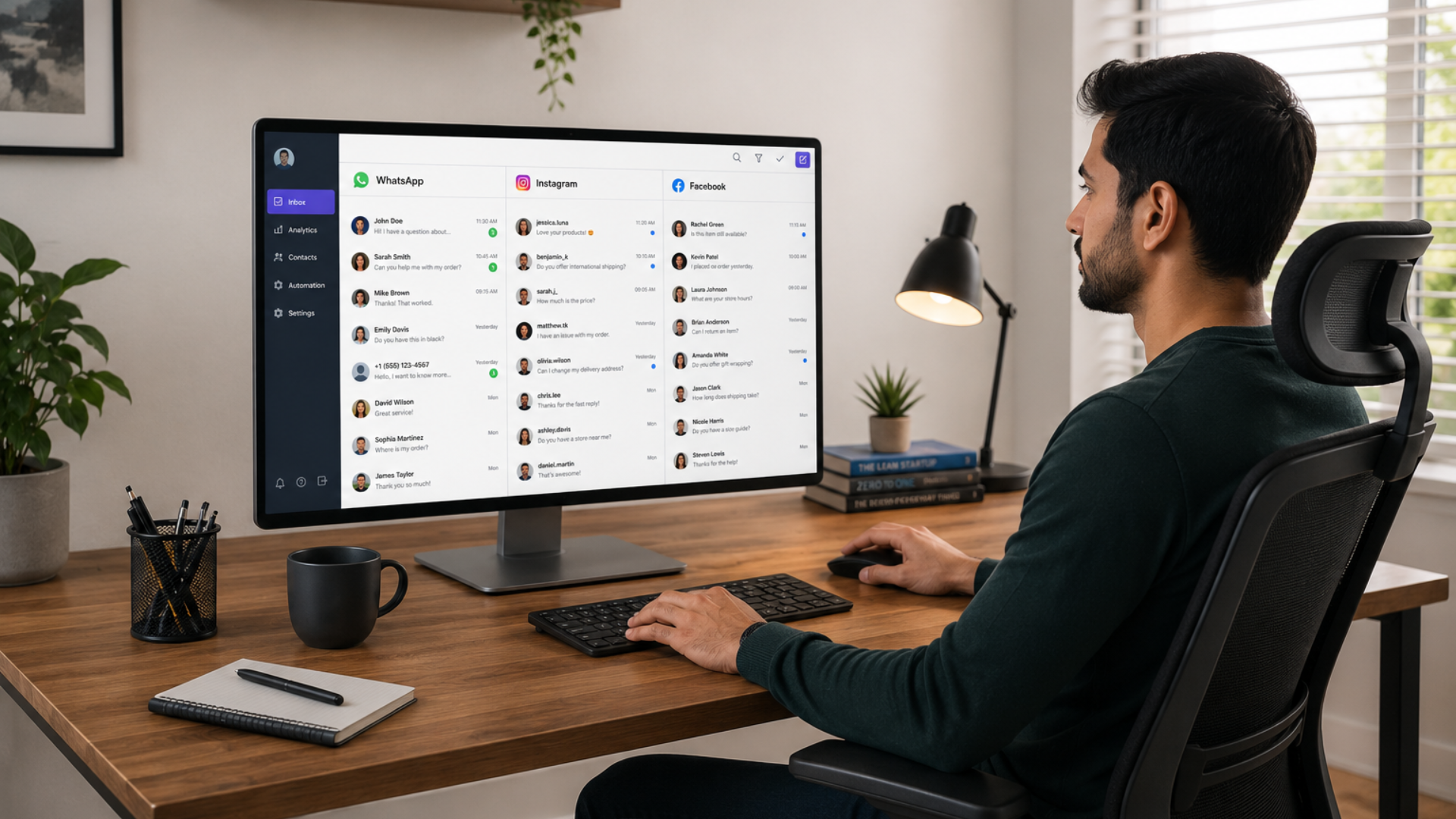
How to Handle WhatsApp  Instagram and Facebook DMs in Just One Window


Customers Are Messaging You Everywhere. So Why Does It Still Feel Like You’re Missing Opportunities?

Imagine it’s a busy Monday morning. Before you’ve even finished your first cup of coffee, your phone is already buzzing with notifications.

A customer has sent a message on WhatsApp asking about your pricing. Someone else has commented on your latest Instagram post requesting more information. A Facebook Messenger notification appears a few minutes later, followed by another inquiry from your website. Your team starts responding as quickly as they can, but with conversations happening across different platforms, keeping track of everything becomes much harder than expected.

At first, it doesn’t seem like a serious problem. Opening a few different apps throughout the day feels manageable, especially when the number of inquiries is still low. Many growing businesses operate this way in the beginning, switching between WhatsApp, Instagram, Facebook, email, and phone calls without giving it much thought.

The challenge begins when your business starts attracting more attention. Marketing campaigns become more successful. Social media engagement increases. Customers find you through different channels, and suddenly those few daily messages become dozens or even hundreds. Instead of focusing on building relationships and closing sales, your team spends a large part of the day simply trying to keep up with notifications.

This is where many businesses unknowingly start losing opportunities. Not because they offer poor products. Not because their pricing is wrong. And certainly not because customers aren’t interested. They lose opportunities because their customer conversations are scattered across too many places.

Every new platform creates another inbox to monitor. Every team member develops their own way of managing conversations. Before long, nobody has a complete picture of what has already been discussed with a customer, who replied last, or whether someone is still waiting for an answer.

It is a problem that grows quietly in the background. Most businesses only realize how much it is affecting them after customers begin following up with messages like, “Just checking if you saw my message,” or “I already shared these details yesterday.”

By that stage, the issue is no longer about communication. It has started affecting customer trust. The good news is that this isn’t a people problem. It is a systems problem. Once conversations become organized in one place instead of being scattered across multiple apps, responding to customers becomes faster, teamwork becomes smoother, and every inquiry becomes much easier to manage.

The Problem Isn’t Getting More Messages. It’s Managing Them.

Every business wants more customer inquiries. More messages usually mean more interest, more opportunities, and ultimately more potential sales. Marketing teams spend months trying to achieve exactly that by creating engaging content, running advertisements, improving search engine rankings, and encouraging referrals.

When those efforts finally begin generating results, it should feel like a success. Instead, many businesses find themselves dealing with an entirely new challenge. As inquiry volumes increase, communication becomes surprisingly difficult to manage. A salesperson replies to customers on WhatsApp while another team member handles Instagram messages. Someone else monitors Facebook comments, and website inquiries arrive through email or contact forms. Since every platform operates independently, the team constantly switches between applications just to stay updated.

The process might only take a few extra seconds each time, but those seconds quickly add up throughout the day. More importantly, every time someone changes platforms, they also change context. They have to remember which customer they were speaking with, what information has already been shared, whether someone else responded earlier, and what the next step should be.

Now imagine this happening not five or ten times a day, but hundreds of times. Instead of having meaningful conversations with customers, employees spend a surprising amount of time searching for conversations, checking notifications, and making sure nothing has been overlooked. The work feels busy, but much of that effort is spent managing communication rather than actually helping customers.

This is one of the biggest operational challenges for growing businesses today. Customer communication has expanded across multiple platforms, but the way many businesses manage it hasn’t changed. Teams are still treating every messaging channel as a separate workspace, even though customers expect one consistent experience regardless of where they choose to reach out.

From the customer’s perspective, they are simply talking to your business. They don’t care whether they contacted you through WhatsApp, Instagram, or Facebook. They expect your team to know who they are, understand their previous questions, and continue the conversation without asking them to repeat everything from the beginning. When that doesn’t happen, the experience immediately feels disconnected. And when customers have a poor communication experience, it often doesn’t matter how good your product or service actually is.


The Hidden Cost of Switching Between Apps All Day

When business owners think about productivity, they usually focus on obvious factors like hiring more people, improving processes, or investing in better software. What often goes unnoticed is how much time teams lose simply by moving from one application to another throughout the day.

A sales representative replies to a customer on WhatsApp, then immediately switches to Instagram to answer a direct message. Before finishing that conversation, a Facebook Messenger notification appears. A few minutes later, another inquiry arrives through the website. Individually, these tasks don’t seem difficult. Together, however, they create a constant cycle of interruptions that makes it harder for employees to stay focused and work efficiently.

The problem isn’t just the extra clicks required to open another app. Every time someone switches platforms, they also have to switch their attention. They need to remember the context of the conversation, check previous messages, understand what has already been discussed, and figure out the next step. That mental shift may only take a few moments, but when repeated dozens of times every day, it significantly slows down the entire team.

As businesses grow, this scattered way of working becomes even more challenging. More customers mean more conversations happening simultaneously. Different team members begin handling different platforms, making it increasingly difficult to understand who is responsible for which customer. Instead of working together, everyone starts managing their own inbox, creating information silos across the business.

The result is a communication process that feels busy all day but never completely under control.


When Conversations Are Scattered, Mistakes Become Inevitable

No business intentionally ignores customers. In most cases, missed messages and delayed replies happen because communication is spread across too many places. Imagine a customer first sends an Instagram message asking about your services. Later that afternoon, they decide to continue the conversation on WhatsApp because it feels more convenient. Since those conversations exist in separate applications, the employee responding on WhatsApp may have no idea the customer already received information earlier that day.

Instead of continuing the conversation naturally, they start asking the same questions again. From the customer’s perspective, it feels like the business isn’t paying attention. These situations happen far more often than many businesses realize. A team member believes someone else has already replied, so the message remains unanswered. Two employees unknowingly respond to the same inquiry, creating confusion. Important details shared through one platform never reach the person handling another platform. Customers repeat themselves, wait longer than expected, or eventually stop responding altogether.

None of these problems occur because employees lack commitment. They happen because people are trying to manage a growing number of conversations using disconnected tools that were never designed to work together. The larger the business becomes, the greater the risk. A missed message today isn’t just a delayed reply. It could be a lost sale, a frustrated customer, or a negative first impression that encourages someone to choose a competitor instead.


Customers Expect One Business, Not Three Different Conversations

Technology has changed the way customers communicate, but it has also changed their expectations. Today’s customers don’t think in terms of communication channels. They simply choose whichever platform feels most convenient at that moment. One day they might discover your business through an Instagram Reel. The next day they send a WhatsApp message asking for pricing. A few days later, they respond to a Facebook post after seeing one of your promotions.

To the customer, these interactions are all part of one conversation. They naturally expect your business to remember who they are, what they asked previously, and where the discussion left off. They don’t expect to introduce themselves every time they switch platforms or explain the same requirement to different employees.

Unfortunately, this is exactly what many businesses unintentionally ask customers to do. When conversations remain disconnected, every interaction starts feeling like a fresh inquiry instead of a continuation of an existing relationship. Customers repeat information, resend documents, explain their requirements again, and answer the same questions multiple times.

Over time, these small frustrations begin affecting trust. Customers often associate organized communication with professional service. If a business struggles to keep track of conversations before the sale, many people naturally wonder what support will be like after they become a customer.

That’s why improving communication isn’t just about saving time for your team. It’s about creating an experience that makes customers feel valued, remembered, and confident that they’re dealing with a business that genuinely has everything under control.


Bringing Every Customer Conversation Into One Place

If scattered conversations create confusion, the obvious question becomes: what does a better approach actually look like? The answer isn’t asking employees to work harder or remember more. It isn’t creating another spreadsheet to track customer inquiries or setting up a dozen reminders throughout the day. Those solutions may help temporarily, but they don’t solve the underlying problem.

The real improvement comes from changing where conversations are managed. Instead of asking your team to monitor WhatsApp, Instagram, Facebook, and other communication channels separately, businesses can bring every customer conversation into a single workspace. Rather than jumping between multiple applications, employees work from one window where they can see incoming messages, continue conversations, and collaborate with other team members without constantly changing platforms.

This changes the way communication feels throughout the day. Instead of wondering where a customer reached out, employees simply open one dashboard and respond. Whether the inquiry started on Instagram, continued on WhatsApp, or came through Facebook Messenger, everything is available in one place. The team no longer spends valuable time searching for conversations because the conversations come to them.

The biggest advantage isn’t convenience. It’s consistency. When everyone works from the same communication hub, every customer receives a more organized experience. Team members can quickly understand previous interactions, continue conversations naturally, and avoid asking customers to repeat information they’ve already shared. The business begins operating as one connected team instead of several people managing separate inboxes.

As customer inquiries continue growing, this becomes even more valuable because the system grows with the business instead of becoming another bottleneck.


Why Team Collaboration Becomes Much Easier

Managing customer conversations isn’t only about replying quickly. It’s also about making sure the right person responds at the right time. In many businesses, customer inquiries rarely stay with one employee from start to finish. A marketing executive might answer the initial question. A salesperson may handle pricing discussions. Later, a support representative could assist after the purchase. Each person plays a different role, but the customer expects the experience to remain smooth throughout.

When conversations are spread across different apps, that handover often becomes difficult. Employees forward screenshots, copy and paste chat histories, or explain previous discussions to colleagues before they can continue helping the customer. Apart from taking extra time, this creates unnecessary opportunities for important details to be missed.

Working from one shared communication platform removes much of that complexity. Every conversation remains accessible to authorized team members, allowing anyone involved to understand the customer’s journey without asking for updates from colleagues. Internal notes, previous messages, customer details, and conversation history remain connected, making collaboration feel far more natural.

It also creates greater accountability within the team. Managers can easily see which conversations are waiting for a response, which team member is handling a customer, and where additional support might be needed. Instead of relying on verbal updates or manual tracking, everyone works with the same information in real time.

For growing businesses, this level of visibility becomes increasingly important. It helps teams respond faster, reduces misunderstandings, and creates a more consistent customer experience without adding unnecessary administrative work.


Faster Responses Without Making Customers Wait

One of the biggest reasons businesses lose potential customers isn’t because they fail to respond. It’s because they don’t respond quickly enough. Modern customers have more choices than ever before. If someone sends an inquiry to your business, there’s a good chance they’ve also contacted one or two competitors. While they’re waiting for your reply, another business may already be answering their questions, sharing pricing information, or booking a consultation.

In many cases, the first meaningful conversation gains the biggest advantage. This doesn’t mean businesses should rush every reply without understanding the customer’s needs. It simply means they shouldn’t lose valuable time because employees are searching through different applications or trying to figure out who should respond.

When all customer conversations arrive in one place, the response process becomes much more efficient. Team members spend less time navigating between platforms and more time actually helping customers. New inquiries become easier to identify, ongoing conversations are simple to continue, and important messages are far less likely to be overlooked.

The improvement isn’t measured only in minutes saved. It creates momentum. Customers receive timely responses while they’re still actively looking for information. Questions get answered before interest fades. Conversations move naturally toward the next step instead of stopping because someone forgot to check another messaging app.

That consistency doesn’t just improve customer satisfaction. It also gives businesses a better opportunity to convert inquiries into genuine sales.


Intelligent Routing: Making Sure Every Conversation Reaches the Right Person

As businesses grow, responding to customer messages is only one part of the challenge. The other part is making sure those conversations reach the right person without unnecessary delays.

Think about the variety of inquiries a business receives in a single day. One customer wants to know about pricing, another is asking for technical support, someone else is interested in becoming a reseller, while another customer is following up on an existing order. Although all these conversations begin the same way with a message they usually require different teams to handle them.

Many businesses still manage this manually. A receptionist forwards messages to the sales team. Sales forwards certain inquiries to support. Support asks another department for information before responding to the customer. Throughout this process, valuable time is lost, and customers are left waiting while conversations move from one employee to another.

As inquiry volumes increase, this approach becomes difficult to maintain. Instead of relying on manual forwarding, businesses benefit from having conversations automatically routed based on predefined rules. A sales inquiry can immediately reach the sales team. Existing customers can be directed to support. Partnership requests can be assigned to the appropriate manager without anyone needing to manually transfer the conversation.

The customer experiences a much smoother journey because they’re connected with the right person from the very beginning, while employees spend less time managing conversations and more time resolving them.

Behind the scenes, it creates a far more organized way of working. Every inquiry has a clear owner, responsibilities become easier to manage, and conversations are much less likely to remain unanswered simply because nobody realized they needed attention.


Every Customer Deserves One Continuous Conversation

One of the biggest frustrations customers face is having to start over every time they contact a business through a different platform.  Imagine someone first discovers your company on Instagram and sends a message asking about your services. A day later, they decide to continue the conversation on WhatsApp because it’s easier to chat there. A few days after that, they respond to a Facebook advertisement asking another question before making their final decision.

From the customer’s perspective, these are all part of the same buying journey. They don’t see three different platforms. They see one business. When employees also have access to one complete conversation history, they can continue helping the customer naturally without repeating the same questions or searching for information in different places. Previous discussions, shared documents, customer details, and follow-up notes remain connected, allowing every interaction to feel like a continuation rather than a fresh start.

This doesn’t just improve efficiency for employees. It creates a better experience for customers because they feel remembered. Customers appreciate businesses that understand their history, respond with context, and continue conversations without asking them to explain everything again. These small experiences build confidence and make the business appear more professional, organized, and attentive. Over time, those positive experiences become one of the reasons customers choose to continue working with the business rather than looking elsewhere.


How ihakimi Helps Businesses Stay in Control of Customer Conversations

As customer communication becomes more complex, businesses need more than just another messaging application. They need a system that helps their team stay organized while delivering a consistent experience across every channel.

That’s exactly where ihakimi helps. Instead of managing WhatsApp, Instagram, Facebook Messenger, website inquiries, and other communication channels separately, ihakimi brings them together into a single workspace where teams can handle conversations more efficiently. Employees no longer need to keep multiple applications open throughout the day or wonder where the next customer message will appear.

Every inquiry can be viewed from one place, making it easier to respond quickly and maintain continuity across conversations. Beyond centralizing messages, ihakimi also helps businesses organize the way conversations are handled. Teams can assign inquiries to the right employees, monitor ongoing discussions, add internal notes, and keep customer information connected throughout the entire journey. Managers gain better visibility into team performance, while employees spend less time searching for conversations and more time helping customers.

The goal isn’t simply to make communication easier. It’s to create a customer experience that feels professional from the very first message. Whether a customer reaches out through WhatsApp, Instagram, Facebook, or another connected channel, your team can respond with confidence, knowing they have the information and context needed to continue the conversation without interruption.

As businesses continue growing, that level of organization becomes one of the biggest advantages they can have.


Better Communication Doesn’t Start with More Apps. It Starts with Better Systems.

Many businesses believe that responding faster simply means hiring more employees or asking existing teams to work harder. In reality, neither solution addresses the root of the problem.

When customer conversations remain scattered across different platforms, even the most dedicated team will eventually struggle to keep up. Messages become difficult to track, follow-ups are delayed, customers repeat themselves, and opportunities quietly slip away, not because people aren’t working hard, but because the system they’re working with makes communication unnecessarily complicated. Bringing every conversation into one place changes that.

Instead of switching between applications all day, your team works from a single workspace where every customer interaction is visible, organized, and easy to manage. Conversations move to the right people faster, collaboration becomes smoother, and customers receive the consistent experience they expect regardless of how they choose to contact your business.

  • For customers, it feels effortless.
  • For employees, it feels organized.
  • For business owners, it creates greater confidence that no inquiry is being overlooked and no opportunity is being lost because of fragmented communication.

As customer expectations continue to rise, businesses that simplify communication will always be better positioned to build stronger relationships, respond faster, and convert more inquiries into loyal customers.

If your team spends more time switching between messaging apps than actually speaking with customers, it may be time to rethink the way your business manages communication. With ihakimi, every conversation comes together in one place, helping your team stay organized, respond faster, and deliver the seamless customer experience that today’s customers expect.


Wrapping It Up

Growing a business has never been just about attracting more customers. It’s about being ready when those customers decide to reach out.

Today, people expect businesses to be available on the platforms they already use. Some prefer WhatsApp because it’s quick and familiar. Others send a direct message on Instagram after discovering a product through social media. Many still use Facebook Messenger to ask questions or inquire about services. While these different channels make it easier for customers to connect with your business, they can also make communication much harder to manage if every conversation lives in a different place.

As the number of inquiries increases, so does the complexity. Teams spend more time switching between applications, searching for previous conversations, forwarding messages internally, and trying to ensure that nothing gets missed. These may seem like small operational challenges, but over time they begin affecting response times, customer satisfaction, and ultimately sales.

The good news is that solving this problem doesn’t require your team to work longer hours or constantly monitor multiple apps throughout the day. It simply requires a better way of managing customer communication.

When every WhatsApp message, Instagram DM, Facebook Messenger conversation, and customer inquiry is available in one place, communication becomes far more organized. Employees know exactly where to respond, managers gain better visibility into ongoing conversations, and customers enjoy a smoother experience because they no longer have to repeat themselves every time they reach out.

More importantly, your team can focus on what actually drives business growth. Instead of spending valuable time switching between applications and searching for information, they can dedicate their attention to answering questions, building relationships, solving customer problems, and moving conversations toward meaningful outcomes.

Technology should reduce complexity, not create more of it. The businesses that consistently deliver great customer experiences are rarely the ones using the most software. They are the ones using the right systems to bring everything together in a way that feels simple for both employees and customers.

At ihakimi, we help businesses centralize customer communication so teams can manage WhatsApp, Instagram, Facebook Messenger, website inquiries, and other conversations from one organized workspace. With every interaction connected, businesses can respond faster, collaborate more effectively, and ensure that every customer receives the attention they deserve.

As customer expectations continue to evolve, staying organized isn’t just an operational improvement. It’s becoming a competitive advantage. If your business is ready to simplify communication, reduce missed opportunities, and create a better experience for every customer, bringing all your conversations into one place is one of the smartest places to start.

How to Handle WhatsApp  Instagram and Facebook DMs in Just One Window


Customers Are Messaging You Everywhere. So Why Does It Still Feel Like You’re Missing Opportunities?

Imagine it’s a busy Monday morning. Before you’ve even finished your first cup of coffee, your phone is already buzzing with notifications.

A customer has sent a message on WhatsApp asking about your pricing. Someone else has commented on your latest Instagram post requesting more information. A Facebook Messenger notification appears a few minutes later, followed by another inquiry from your website. Your team starts responding as quickly as they can, but with conversations happening across different platforms, keeping track of everything becomes much harder than expected.

At first, it doesn’t seem like a serious problem. Opening a few different apps throughout the day feels manageable, especially when the number of inquiries is still low. Many growing businesses operate this way in the beginning, switching between WhatsApp, Instagram, Facebook, email, and phone calls without giving it much thought.

The challenge begins when your business starts attracting more attention. Marketing campaigns become more successful. Social media engagement increases. Customers find you through different channels, and suddenly those few daily messages become dozens or even hundreds. Instead of focusing on building relationships and closing sales, your team spends a large part of the day simply trying to keep up with notifications.

This is where many businesses unknowingly start losing opportunities. Not because they offer poor products. Not because their pricing is wrong. And certainly not because customers aren’t interested. They lose opportunities because their customer conversations are scattered across too many places.

Every new platform creates another inbox to monitor. Every team member develops their own way of managing conversations. Before long, nobody has a complete picture of what has already been discussed with a customer, who replied last, or whether someone is still waiting for an answer.

It is a problem that grows quietly in the background. Most businesses only realize how much it is affecting them after customers begin following up with messages like, “Just checking if you saw my message,” or “I already shared these details yesterday.”

By that stage, the issue is no longer about communication. It has started affecting customer trust. The good news is that this isn’t a people problem. It is a systems problem. Once conversations become organized in one place instead of being scattered across multiple apps, responding to customers becomes faster, teamwork becomes smoother, and every inquiry becomes much easier to manage.

The Problem Isn’t Getting More Messages. It’s Managing Them.

Every business wants more customer inquiries. More messages usually mean more interest, more opportunities, and ultimately more potential sales. Marketing teams spend months trying to achieve exactly that by creating engaging content, running advertisements, improving search engine rankings, and encouraging referrals.

When those efforts finally begin generating results, it should feel like a success. Instead, many businesses find themselves dealing with an entirely new challenge. As inquiry volumes increase, communication becomes surprisingly difficult to manage. A salesperson replies to customers on WhatsApp while another team member handles Instagram messages. Someone else monitors Facebook comments, and website inquiries arrive through email or contact forms. Since every platform operates independently, the team constantly switches between applications just to stay updated.

The process might only take a few extra seconds each time, but those seconds quickly add up throughout the day. More importantly, every time someone changes platforms, they also change context. They have to remember which customer they were speaking with, what information has already been shared, whether someone else responded earlier, and what the next step should be.

Now imagine this happening not five or ten times a day, but hundreds of times. Instead of having meaningful conversations with customers, employees spend a surprising amount of time searching for conversations, checking notifications, and making sure nothing has been overlooked. The work feels busy, but much of that effort is spent managing communication rather than actually helping customers.

This is one of the biggest operational challenges for growing businesses today. Customer communication has expanded across multiple platforms, but the way many businesses manage it hasn’t changed. Teams are still treating every messaging channel as a separate workspace, even though customers expect one consistent experience regardless of where they choose to reach out.

From the customer’s perspective, they are simply talking to your business. They don’t care whether they contacted you through WhatsApp, Instagram, or Facebook. They expect your team to know who they are, understand their previous questions, and continue the conversation without asking them to repeat everything from the beginning. When that doesn’t happen, the experience immediately feels disconnected. And when customers have a poor communication experience, it often doesn’t matter how good your product or service actually is.


The Hidden Cost of Switching Between Apps All Day

When business owners think about productivity, they usually focus on obvious factors like hiring more people, improving processes, or investing in better software. What often goes unnoticed is how much time teams lose simply by moving from one application to another throughout the day.

A sales representative replies to a customer on WhatsApp, then immediately switches to Instagram to answer a direct message. Before finishing that conversation, a Facebook Messenger notification appears. A few minutes later, another inquiry arrives through the website. Individually, these tasks don’t seem difficult. Together, however, they create a constant cycle of interruptions that makes it harder for employees to stay focused and work efficiently.

The problem isn’t just the extra clicks required to open another app. Every time someone switches platforms, they also have to switch their attention. They need to remember the context of the conversation, check previous messages, understand what has already been discussed, and figure out the next step. That mental shift may only take a few moments, but when repeated dozens of times every day, it significantly slows down the entire team.

As businesses grow, this scattered way of working becomes even more challenging. More customers mean more conversations happening simultaneously. Different team members begin handling different platforms, making it increasingly difficult to understand who is responsible for which customer. Instead of working together, everyone starts managing their own inbox, creating information silos across the business.

The result is a communication process that feels busy all day but never completely under control.


When Conversations Are Scattered, Mistakes Become Inevitable

No business intentionally ignores customers. In most cases, missed messages and delayed replies happen because communication is spread across too many places. Imagine a customer first sends an Instagram message asking about your services. Later that afternoon, they decide to continue the conversation on WhatsApp because it feels more convenient. Since those conversations exist in separate applications, the employee responding on WhatsApp may have no idea the customer already received information earlier that day.

Instead of continuing the conversation naturally, they start asking the same questions again. From the customer’s perspective, it feels like the business isn’t paying attention. These situations happen far more often than many businesses realize. A team member believes someone else has already replied, so the message remains unanswered. Two employees unknowingly respond to the same inquiry, creating confusion. Important details shared through one platform never reach the person handling another platform. Customers repeat themselves, wait longer than expected, or eventually stop responding altogether.

None of these problems occur because employees lack commitment. They happen because people are trying to manage a growing number of conversations using disconnected tools that were never designed to work together. The larger the business becomes, the greater the risk. A missed message today isn’t just a delayed reply. It could be a lost sale, a frustrated customer, or a negative first impression that encourages someone to choose a competitor instead.


Customers Expect One Business, Not Three Different Conversations

Technology has changed the way customers communicate, but it has also changed their expectations. Today’s customers don’t think in terms of communication channels. They simply choose whichever platform feels most convenient at that moment. One day they might discover your business through an Instagram Reel. The next day they send a WhatsApp message asking for pricing. A few days later, they respond to a Facebook post after seeing one of your promotions.

To the customer, these interactions are all part of one conversation. They naturally expect your business to remember who they are, what they asked previously, and where the discussion left off. They don’t expect to introduce themselves every time they switch platforms or explain the same requirement to different employees.

Unfortunately, this is exactly what many businesses unintentionally ask customers to do. When conversations remain disconnected, every interaction starts feeling like a fresh inquiry instead of a continuation of an existing relationship. Customers repeat information, resend documents, explain their requirements again, and answer the same questions multiple times.

Over time, these small frustrations begin affecting trust. Customers often associate organized communication with professional service. If a business struggles to keep track of conversations before the sale, many people naturally wonder what support will be like after they become a customer.

That’s why improving communication isn’t just about saving time for your team. It’s about creating an experience that makes customers feel valued, remembered, and confident that they’re dealing with a business that genuinely has everything under control.


Bringing Every Customer Conversation Into One Place

If scattered conversations create confusion, the obvious question becomes: what does a better approach actually look like? The answer isn’t asking employees to work harder or remember more. It isn’t creating another spreadsheet to track customer inquiries or setting up a dozen reminders throughout the day. Those solutions may help temporarily, but they don’t solve the underlying problem.

The real improvement comes from changing where conversations are managed. Instead of asking your team to monitor WhatsApp, Instagram, Facebook, and other communication channels separately, businesses can bring every customer conversation into a single workspace. Rather than jumping between multiple applications, employees work from one window where they can see incoming messages, continue conversations, and collaborate with other team members without constantly changing platforms.

This changes the way communication feels throughout the day. Instead of wondering where a customer reached out, employees simply open one dashboard and respond. Whether the inquiry started on Instagram, continued on WhatsApp, or came through Facebook Messenger, everything is available in one place. The team no longer spends valuable time searching for conversations because the conversations come to them.

The biggest advantage isn’t convenience. It’s consistency. When everyone works from the same communication hub, every customer receives a more organized experience. Team members can quickly understand previous interactions, continue conversations naturally, and avoid asking customers to repeat information they’ve already shared. The business begins operating as one connected team instead of several people managing separate inboxes.

As customer inquiries continue growing, this becomes even more valuable because the system grows with the business instead of becoming another bottleneck.


Why Team Collaboration Becomes Much Easier

Managing customer conversations isn’t only about replying quickly. It’s also about making sure the right person responds at the right time. In many businesses, customer inquiries rarely stay with one employee from start to finish. A marketing executive might answer the initial question. A salesperson may handle pricing discussions. Later, a support representative could assist after the purchase. Each person plays a different role, but the customer expects the experience to remain smooth throughout.

When conversations are spread across different apps, that handover often becomes difficult. Employees forward screenshots, copy and paste chat histories, or explain previous discussions to colleagues before they can continue helping the customer. Apart from taking extra time, this creates unnecessary opportunities for important details to be missed.

Working from one shared communication platform removes much of that complexity. Every conversation remains accessible to authorized team members, allowing anyone involved to understand the customer’s journey without asking for updates from colleagues. Internal notes, previous messages, customer details, and conversation history remain connected, making collaboration feel far more natural.

It also creates greater accountability within the team. Managers can easily see which conversations are waiting for a response, which team member is handling a customer, and where additional support might be needed. Instead of relying on verbal updates or manual tracking, everyone works with the same information in real time.

For growing businesses, this level of visibility becomes increasingly important. It helps teams respond faster, reduces misunderstandings, and creates a more consistent customer experience without adding unnecessary administrative work.


Faster Responses Without Making Customers Wait

One of the biggest reasons businesses lose potential customers isn’t because they fail to respond. It’s because they don’t respond quickly enough. Modern customers have more choices than ever before. If someone sends an inquiry to your business, there’s a good chance they’ve also contacted one or two competitors. While they’re waiting for your reply, another business may already be answering their questions, sharing pricing information, or booking a consultation.

In many cases, the first meaningful conversation gains the biggest advantage. This doesn’t mean businesses should rush every reply without understanding the customer’s needs. It simply means they shouldn’t lose valuable time because employees are searching through different applications or trying to figure out who should respond.

When all customer conversations arrive in one place, the response process becomes much more efficient. Team members spend less time navigating between platforms and more time actually helping customers. New inquiries become easier to identify, ongoing conversations are simple to continue, and important messages are far less likely to be overlooked.

The improvement isn’t measured only in minutes saved. It creates momentum. Customers receive timely responses while they’re still actively looking for information. Questions get answered before interest fades. Conversations move naturally toward the next step instead of stopping because someone forgot to check another messaging app.

That consistency doesn’t just improve customer satisfaction. It also gives businesses a better opportunity to convert inquiries into genuine sales.


Intelligent Routing: Making Sure Every Conversation Reaches the Right Person

As businesses grow, responding to customer messages is only one part of the challenge. The other part is making sure those conversations reach the right person without unnecessary delays.

Think about the variety of inquiries a business receives in a single day. One customer wants to know about pricing, another is asking for technical support, someone else is interested in becoming a reseller, while another customer is following up on an existing order. Although all these conversations begin the same way with a message they usually require different teams to handle them.

Many businesses still manage this manually. A receptionist forwards messages to the sales team. Sales forwards certain inquiries to support. Support asks another department for information before responding to the customer. Throughout this process, valuable time is lost, and customers are left waiting while conversations move from one employee to another.

As inquiry volumes increase, this approach becomes difficult to maintain. Instead of relying on manual forwarding, businesses benefit from having conversations automatically routed based on predefined rules. A sales inquiry can immediately reach the sales team. Existing customers can be directed to support. Partnership requests can be assigned to the appropriate manager without anyone needing to manually transfer the conversation.

The customer experiences a much smoother journey because they’re connected with the right person from the very beginning, while employees spend less time managing conversations and more time resolving them.

Behind the scenes, it creates a far more organized way of working. Every inquiry has a clear owner, responsibilities become easier to manage, and conversations are much less likely to remain unanswered simply because nobody realized they needed attention.


Every Customer Deserves One Continuous Conversation

One of the biggest frustrations customers face is having to start over every time they contact a business through a different platform.  Imagine someone first discovers your company on Instagram and sends a message asking about your services. A day later, they decide to continue the conversation on WhatsApp because it’s easier to chat there. A few days after that, they respond to a Facebook advertisement asking another question before making their final decision.

From the customer’s perspective, these are all part of the same buying journey. They don’t see three different platforms. They see one business. When employees also have access to one complete conversation history, they can continue helping the customer naturally without repeating the same questions or searching for information in different places. Previous discussions, shared documents, customer details, and follow-up notes remain connected, allowing every interaction to feel like a continuation rather than a fresh start.

This doesn’t just improve efficiency for employees. It creates a better experience for customers because they feel remembered. Customers appreciate businesses that understand their history, respond with context, and continue conversations without asking them to explain everything again. These small experiences build confidence and make the business appear more professional, organized, and attentive. Over time, those positive experiences become one of the reasons customers choose to continue working with the business rather than looking elsewhere.


How ihakimi Helps Businesses Stay in Control of Customer Conversations

As customer communication becomes more complex, businesses need more than just another messaging application. They need a system that helps their team stay organized while delivering a consistent experience across every channel.

That’s exactly where ihakimi helps. Instead of managing WhatsApp, Instagram, Facebook Messenger, website inquiries, and other communication channels separately, ihakimi brings them together into a single workspace where teams can handle conversations more efficiently. Employees no longer need to keep multiple applications open throughout the day or wonder where the next customer message will appear.

Every inquiry can be viewed from one place, making it easier to respond quickly and maintain continuity across conversations. Beyond centralizing messages, ihakimi also helps businesses organize the way conversations are handled. Teams can assign inquiries to the right employees, monitor ongoing discussions, add internal notes, and keep customer information connected throughout the entire journey. Managers gain better visibility into team performance, while employees spend less time searching for conversations and more time helping customers.

The goal isn’t simply to make communication easier. It’s to create a customer experience that feels professional from the very first message. Whether a customer reaches out through WhatsApp, Instagram, Facebook, or another connected channel, your team can respond with confidence, knowing they have the information and context needed to continue the conversation without interruption.

As businesses continue growing, that level of organization becomes one of the biggest advantages they can have.


Better Communication Doesn’t Start with More Apps. It Starts with Better Systems.

Many businesses believe that responding faster simply means hiring more employees or asking existing teams to work harder. In reality, neither solution addresses the root of the problem.

When customer conversations remain scattered across different platforms, even the most dedicated team will eventually struggle to keep up. Messages become difficult to track, follow-ups are delayed, customers repeat themselves, and opportunities quietly slip away, not because people aren’t working hard, but because the system they’re working with makes communication unnecessarily complicated. Bringing every conversation into one place changes that.

Instead of switching between applications all day, your team works from a single workspace where every customer interaction is visible, organized, and easy to manage. Conversations move to the right people faster, collaboration becomes smoother, and customers receive the consistent experience they expect regardless of how they choose to contact your business.

  • For customers, it feels effortless.
  • For employees, it feels organized.
  • For business owners, it creates greater confidence that no inquiry is being overlooked and no opportunity is being lost because of fragmented communication.

As customer expectations continue to rise, businesses that simplify communication will always be better positioned to build stronger relationships, respond faster, and convert more inquiries into loyal customers.

If your team spends more time switching between messaging apps than actually speaking with customers, it may be time to rethink the way your business manages communication. With ihakimi, every conversation comes together in one place, helping your team stay organized, respond faster, and deliver the seamless customer experience that today’s customers expect.


Wrapping It Up

Growing a business has never been just about attracting more customers. It’s about being ready when those customers decide to reach out.

Today, people expect businesses to be available on the platforms they already use. Some prefer WhatsApp because it’s quick and familiar. Others send a direct message on Instagram after discovering a product through social media. Many still use Facebook Messenger to ask questions or inquire about services. While these different channels make it easier for customers to connect with your business, they can also make communication much harder to manage if every conversation lives in a different place.

As the number of inquiries increases, so does the complexity. Teams spend more time switching between applications, searching for previous conversations, forwarding messages internally, and trying to ensure that nothing gets missed. These may seem like small operational challenges, but over time they begin affecting response times, customer satisfaction, and ultimately sales.

The good news is that solving this problem doesn’t require your team to work longer hours or constantly monitor multiple apps throughout the day. It simply requires a better way of managing customer communication.

When every WhatsApp message, Instagram DM, Facebook Messenger conversation, and customer inquiry is available in one place, communication becomes far more organized. Employees know exactly where to respond, managers gain better visibility into ongoing conversations, and customers enjoy a smoother experience because they no longer have to repeat themselves every time they reach out.

More importantly, your team can focus on what actually drives business growth. Instead of spending valuable time switching between applications and searching for information, they can dedicate their attention to answering questions, building relationships, solving customer problems, and moving conversations toward meaningful outcomes.

Technology should reduce complexity, not create more of it. The businesses that consistently deliver great customer experiences are rarely the ones using the most software. They are the ones using the right systems to bring everything together in a way that feels simple for both employees and customers.

At ihakimi, we help businesses centralize customer communication so teams can manage WhatsApp, Instagram, Facebook Messenger, website inquiries, and other conversations from one organized workspace. With every interaction connected, businesses can respond faster, collaborate more effectively, and ensure that every customer receives the attention they deserve.

As customer expectations continue to evolve, staying organized isn’t just an operational improvement. It’s becoming a competitive advantage. If your business is ready to simplify communication, reduce missed opportunities, and create a better experience for every customer, bringing all your conversations into one place is one of the smartest places to start.

Scroll to Top