
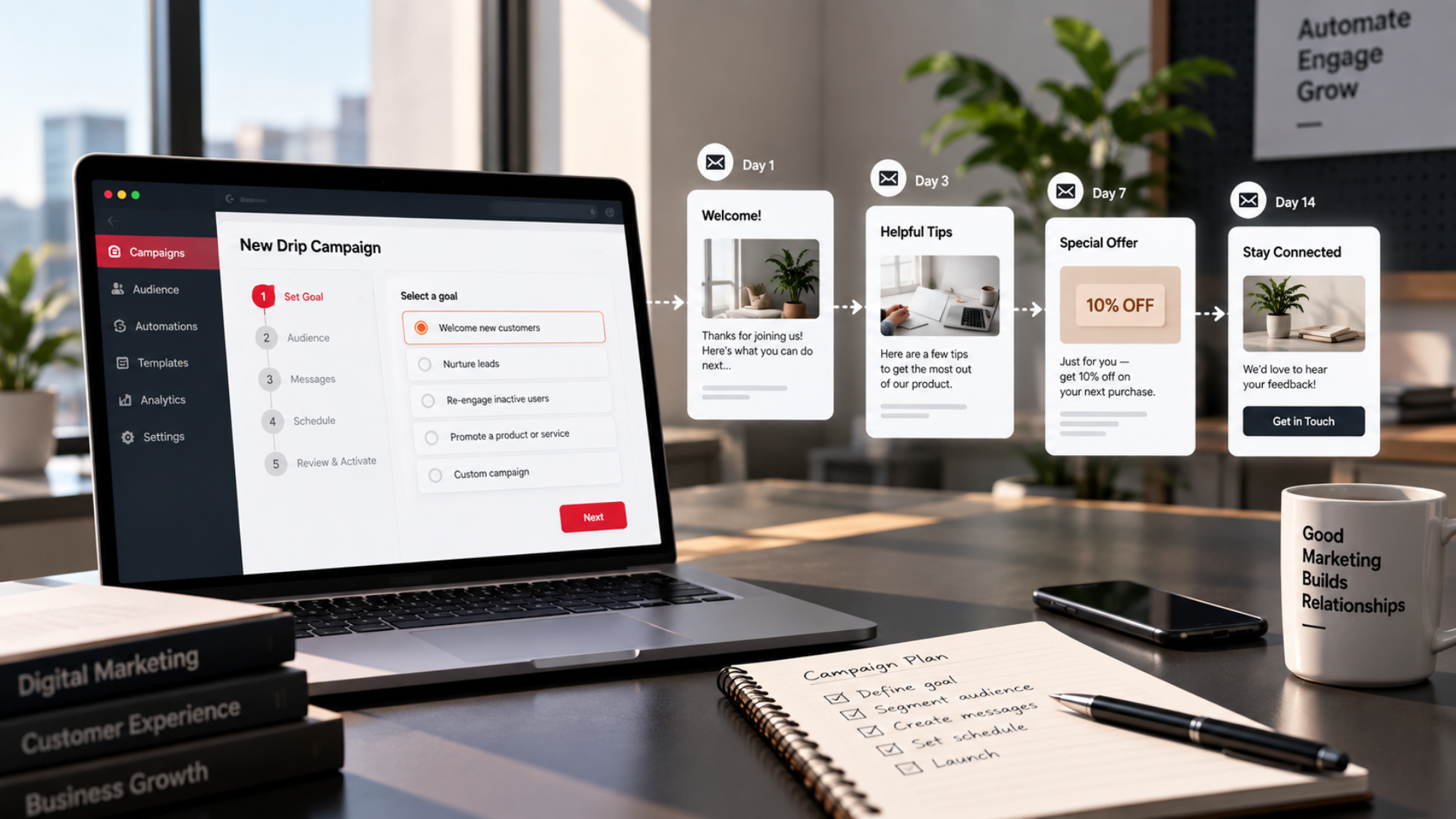
How to Create Automated Drip Campaigns

How to Create Automated Drip Campaigns

A customer rarely makes a decision after a single interaction with a business. Someone may enquire about a service today, read the information they receive, compare a few alternatives, discuss the decision internally, and return several days later. Another customer may sign up for a product but need guidance before they begin using it properly. Someone else may register for an event weeks in advance and need relevant reminders as the date approaches.

The challenge for businesses is not necessarily sending the first message. Most teams are reasonably good at responding when a new enquiry arrives. The difficulty is maintaining the right communication afterward without depending on someone to remember every follow-up, every reminder, and every customer who has not yet taken the next step.

Automated drip campaigns are designed for exactly this kind of communication. Instead of sending one message and hoping the customer returns, a business can create a planned sequence of messages that is delivered over time according to specific triggers, delays, customer segments, and actions. More importantly, a well-designed drip campaign can respond to what happens during the journey rather than blindly sending the complete sequence to everyone.

With ihakimi, businesses can create drip campaigns across channels such as WhatsApp, email, and SMS while connecting those campaigns with customer conversations, segmentation, triggers, conditions, pipelines, and other automation capabilities. The result can be much more useful than a simple series of scheduled reminders.

This blog explains how to plan an automated drip campaign from the beginning, structure the sequence, decide when messages should be sent, account for customer actions, and create a campaign that feels relevant rather than repetitive.


What Is an Automated Drip Campaign?

An automated drip campaign is a sequence of messages that is delivered according to a predefined journey rather than being sent manually one message at a time. The sequence usually begins when a customer meets a particular condition or performs a specific action, after which messages are delivered according to the timing and rules defined by the business.

A simple lead-nurturing campaign might begin when someone submits an enquiry. The first communication could provide the information they requested, followed by another message after an appropriate delay if they have not taken the desired next step. A later message might answer a common concern or provide additional information that helps the customer make a decision.

The important point is that a drip campaign should not be understood as nothing more than Message 1 today, Message 2 tomorrow, and Message 3 two days later. That approach ignores what the customer is doing between those messages.

A more useful campaign asks whether the customer replied, booked, purchased, changed stage, or completed another meaningful action before deciding what should happen next. This turns a scheduled sequence into an actual automated customer journey. Before building any messages, therefore, the first step is to understand exactly what that journey is supposed to achieve.


Step 1: Define One Clear Goal for the Campaign

Every drip campaign should begin with a specific purpose. If the objective is vague, the sequence usually becomes a collection of unrelated promotional messages rather than a meaningful progression. A lead-nurturing campaign, for example, might have the goal of encouraging an interested prospect to schedule a consultation. An onboarding campaign could be designed to help a new customer complete their initial setup. An event campaign might focus on ensuring registered attendees remember the event and receive the information required to participate.

The goal determines what belongs in the sequence. Suppose a business receives enquiries from people interested in booking a product demonstration. If the goal is to get qualified prospects to schedule the demo, every stage of the drip should move naturally toward that outcome. The sequence could provide useful information about the product, address a common question, share a relevant use case, and eventually make the booking step clear.

This is different from creating a campaign that tries to introduce the company, promote five products, request a review, advertise an event, and schedule a demo within the same journey. A drip becomes easier to understand and measure when it is built around one primary outcome. When creating the campaign in ihakimi, that objective should guide the trigger, audience, messages, timing, conditions, and eventual exit from the sequence.


Step 2: Decide Who Should Enter the Drip Campaign

Not every contact in a database should receive every campaign. Relevance begins with deciding who qualifies to enter the sequence. The audience can be based on where the customer came from, what they are interested in, their current stage, previous actions, or other information available to the business. This is where segmentation becomes important.

Consider an education company offering several courses. Someone who enquired specifically about a digital marketing course should not automatically receive the same sequence as someone interested in graphic design. Even if both are technically new leads, their interests are different enough to justify different communication.

The same principle applies to existing customers. A new customer going through onboarding requires a different journey from someone who has already been using the service for six months. A customer who has completed a purchase should not continue receiving a sequence intended to persuade them to make that purchase.

Using ihakimi’s segmentation and automation capabilities, businesses can organize contacts around meaningful criteria and connect the appropriate audience with the appropriate drip journey. The objective should be to make each campaign narrow enough to remain relevant without creating dozens of unnecessary variations that become difficult to manage.


Step 3: Choose the Right Trigger to Start the Journey

Once the audience and objective are clear, the next decision is determining exactly when the drip should begin. The trigger matters because timing affects the context in which every subsequent message is received. A sequence that starts immediately after a customer shows interest feels connected to their action, while the same sequence beginning days later may feel unexpected.

Different business journeys naturally require different starting points. A lead-nurturing drip may begin after an enquiry or another qualifying action. An onboarding sequence could begin after the customer reaches the appropriate stage. A campaign connected to a particular customer status may start when that status changes. The important thing is that entry into the campaign should correspond with something meaningful in the customer’s journey.

For example, imagine someone has requested information about a service. Once that person meets the defined criteria, they can enter the relevant drip. The first communication can acknowledge the interest and provide what was requested. From there, the campaign begins guiding the customer through the next steps. This creates a clear relationship between the customer’s action and the communication that follows, which makes automated messaging feel considerably more natural.


Step 4: Map the Entire Sequence Before Writing the Messages

One of the best ways to create a strong drip campaign is to design the journey before writing individual messages. Start with the trigger and work forward. Suppose the objective is to nurture a new service enquiry. The initial structure could look like this:

Enquiry received → Send requested information → Wait → Check customer status → Send useful follow-up if appropriate → Wait → Check again → Continue, branch, or stop

Thinking this way forces the business to consider what each message is supposed to accomplish. The first message may simply provide what the customer requested. The second could answer a question prospects commonly have before proceeding. The third might explain a relevant use case or clarify the next step. A later message could provide a clear invitation to continue the conversation.

Each communication should add something rather than simply restating the previous message with different wording. This is particularly important because repetitive drip campaigns quickly begin to feel like automated chasing. If every message essentially says, “Are you interested yet?”, the campaign provides little reason for the recipient to keep paying attention.

Mapping the journey first also makes it easier to identify where conditions, human involvement, or alternative branches may be required when the campaign is built inside ihakimi.


Step 5: Choose Timing Based on the Customer Journey

There is no universal rule that says every drip campaign should send messages after 24, 48, and 72 hours. The right timing depends on what the customer is doing and how quickly a decision would normally happen.

A reminder for an event taking place tomorrow naturally requires a shorter interval than a nurturing sequence for a high-value service that customers may consider for several weeks. Similarly, onboarding guidance may work better when delivered according to the stages a new customer is expected to complete rather than being compressed into a few days.

The purpose of the delay is to give the customer enough time to act before another message arrives. With ihakimi’s scheduling and drip capabilities, businesses can define when communication should be delivered instead of relying on employees to remember each follow-up manually. However, automation should not be used as an excuse to communicate more frequently than the customer journey requires.

A useful question to ask before every scheduled step is: Would this message still feel reasonable if an employee were personally sending it to this customer? If the answer is no, the sequence probably needs more space or a better reason for the next message.


Step 6: Use Different Channels Where They Make Sense

Drip campaigns do not necessarily need to exist entirely within one communication channel. Depending on the campaign and the customer’s relationship with the business, different stages may be better suited to WhatsApp, email, or SMS. ihakimi supports campaigns across these channels, allowing businesses to plan communication without treating each platform as an entirely separate process.

The choice of channel should depend on the message itself. A detailed onboarding guide may be more suitable for email, while a short reminder could work better through WhatsApp or SMS. A business should also consider the customer’s consent, communication preferences, and the applicable rules of each channel when designing campaigns.

Using multiple channels does not mean sending the same message everywhere. If a customer has already received an email, immediately repeating identical information on WhatsApp and SMS can make the automation feel excessive. The better approach is to decide what role each channel plays in the journey and use it only where it contributes something useful.


Step 7: Add Conditions So the Campaign Can React

This is where a drip campaign begins to become more intelligent. Imagine a three-message sequence designed to encourage a prospect to book a consultation. The customer books after receiving the first message, but the campaign continues sending Messages 2 and 3 because nobody removed them from the sequence.

The automation technically worked, but the customer experience did not. Conditions help prevent situations like this by checking whether something has changed before the next action occurs. Depending on the workflow, the campaign might need to check whether the customer has replied, completed the intended action, moved to another pipeline stage, or otherwise no longer meets the criteria for the current sequence.

Instead of thinking:

Message → Wait → Message → Wait → Message

the business can design:

Message → Wait → Check condition → Decide next action

This difference is fundamental. A good drip campaign is not simply scheduled; it is responsive to the customer’s progress. ihakimi’s automation capabilities can be used to build these decision points into the journey so contacts do not continue receiving communication that no longer matches their situation.


Step 8: Know When Automation Should Stop

Every drip campaign needs an exit strategy. Businesses often spend considerable time deciding how someone enters an automation but far less time deciding when they should leave it. As a result, customers can continue receiving lead-nurturing messages after purchasing, booking, replying, or moving into an entirely different conversation.

The stopping conditions should relate directly to the campaign’s original objective. If the campaign exists to encourage a demo booking, completing that booking is an obvious reason to exit. If the sequence is designed to nurture a sales opportunity, a meaningful reply may require the automated sequence to pause so a salesperson can continue the conversation personally.

An opt-out request should also be respected according to the communication channel and applicable requirements. This is where human handoff becomes particularly important. Automation should support conversations until human involvement becomes more useful, not compete with the employee who has already started speaking with the customer.

Within a broader ihakimi workflow, the transition from drip communication to an active team conversation can therefore be treated as part of the journey rather than an interruption to it.


Step 9: Test the Campaign Before Sending It to Real Customers

A drip campaign may look straightforward on paper while behaving very differently once triggers, delays and conditions begin interacting. Before activating it for a larger audience, test the entire journey.

Check whether the correct contacts enter the campaign and whether anyone who should be excluded can accidentally enter. Verify the order of the messages, timing between steps, conditions, links, personalization fields, and any movement between different stages or channels.

Then test the exceptions. What happens if the customer replies after the first message? What happens if they complete the goal before the second message? Can someone accidentally enter the same sequence twice? Does the workflow stop where it should? What happens when required customer information is unavailable?

These scenarios matter because customers rarely behave exactly as a workflow diagram predicts. Testing the unusual paths before launch helps ensure that the automation remains sensible even when a recipient does something unexpected.


Step 10: Measure What Happens After the Campaign Goes Live

Launching the drip campaign is not the end of the process. It is the point at which the business begins learning whether the journey actually works. The most useful metrics depend on the objective. An email-focused campaign may look at opens and clicks, while a lead-nurturing journey may care more about replies, qualified conversations, bookings, pipeline movement, or eventual conversions.

A campaign can have excellent message engagement and still fail to produce the business outcome it was designed to achieve. For example, if many recipients read the messages but very few proceed to the next stage, the issue may not be the timing. The call to action could be unclear, the sequence may not address the information customers actually need, or the audience may be too broad.

ihakimi’s analytics and customer journey information can help businesses review how communication is performing and where adjustments may be required. The goal should not be to create a drip once and leave it untouched indefinitely. Customer behaviour, offers, products, and business processes change, and the automation should evolve with them.


A Practical Drip Campaign Example

Consider a software company receiving enquiries from businesses interested in scheduling a product demonstration. Once a prospect meets the relevant criteria, they enter a demo-nurturing drip campaign. The first message provides the information promised at the point of enquiry and explains how the demonstration can be scheduled. The campaign then waits for an appropriate period before checking whether the prospect has taken the next step.

If the demo has already been booked, the lead exits the nurturing sequence and can move into the appropriate booking or sales journey. If no booking has been made, the next message could address a common question businesses usually ask before scheduling a demo. After another suitable delay, the workflow checks the customer’s status again before deciding whether another communication is appropriate.

If the prospect replies during the process, the conversation can be handled by the relevant team member rather than allowing the drip to continue as though nothing happened. The journey therefore becomes:

Qualified enquiry → Relevant information → Wait → Check → Helpful follow-up → Wait → Check → Booked, replied, continued, or exited

The power of this structure is not the number of messages being sent. It is that the automation knows what it is trying to achieve and checks whether the customer still belongs in the journey before continuing.


Building Drip Campaigns With ihakimi

A successful drip campaign brings several parts of customer communication together. The business needs a defined audience, a meaningful trigger, a sequence with useful timing, conditions that respond to customer behaviour, and a clear point where the journey ends or moves to a person.

ihakimi brings these elements into a broader customer engagement environment where businesses can work with WhatsApp, email and SMS campaigns, segmentation, scheduling, automated sequences, customer conversations, conditions, pipelines, analytics, and team handoff. This means the drip does not have to operate as an isolated marketing campaign. It can become part of the customer’s wider journey with the business.

A lead can enter because of a meaningful action, receive communication appropriate to their stage, stop receiving the sequence when their status changes, and continue into a human sales conversation when required. Existing customers can follow completely different journeys designed around onboarding, education, reminders, or re-engagement. The technology provides the ability to automate these steps, but the quality of the campaign still comes from designing the journey carefully.


Wrapping It Up

The best automated drip campaigns do not feel like a business has scheduled five messages and forgotten about them. They feel like each communication arrives because it makes sense at that particular point in the customer’s journey.

Creating that experience begins with a clear objective. Businesses need to decide who should enter the campaign, what event should trigger it, what each message contributes, how long the customer should have to respond, and what conditions should be checked before the next communication is sent.

Equally important is knowing when to stop. A customer who has replied, booked, purchased, moved to another stage, or requested human assistance should not continue receiving messages written for an earlier situation.

With ihakimi, businesses can combine drip campaigns with segmentation, multiple communication channels, triggers, conditions, customer conversations, pipelines, analytics, and human handoff to build journeys that respond to what customers actually do rather than relying entirely on fixed schedules.

Automation is most valuable when it removes the need to remember every routine communication without removing the context behind that communication. A well-designed drip campaign does exactly that: it keeps the conversation moving while allowing the customer’s actions to determine where that conversation should go next.


How to Create Automated Drip Campaigns

A customer rarely makes a decision after a single interaction with a business. Someone may enquire about a service today, read the information they receive, compare a few alternatives, discuss the decision internally, and return several days later. Another customer may sign up for a product but need guidance before they begin using it properly. Someone else may register for an event weeks in advance and need relevant reminders as the date approaches.

The challenge for businesses is not necessarily sending the first message. Most teams are reasonably good at responding when a new enquiry arrives. The difficulty is maintaining the right communication afterward without depending on someone to remember every follow-up, every reminder, and every customer who has not yet taken the next step.

Automated drip campaigns are designed for exactly this kind of communication. Instead of sending one message and hoping the customer returns, a business can create a planned sequence of messages that is delivered over time according to specific triggers, delays, customer segments, and actions. More importantly, a well-designed drip campaign can respond to what happens during the journey rather than blindly sending the complete sequence to everyone.

With ihakimi, businesses can create drip campaigns across channels such as WhatsApp, email, and SMS while connecting those campaigns with customer conversations, segmentation, triggers, conditions, pipelines, and other automation capabilities. The result can be much more useful than a simple series of scheduled reminders.

This blog explains how to plan an automated drip campaign from the beginning, structure the sequence, decide when messages should be sent, account for customer actions, and create a campaign that feels relevant rather than repetitive.


What Is an Automated Drip Campaign?

An automated drip campaign is a sequence of messages that is delivered according to a predefined journey rather than being sent manually one message at a time. The sequence usually begins when a customer meets a particular condition or performs a specific action, after which messages are delivered according to the timing and rules defined by the business.

A simple lead-nurturing campaign might begin when someone submits an enquiry. The first communication could provide the information they requested, followed by another message after an appropriate delay if they have not taken the desired next step. A later message might answer a common concern or provide additional information that helps the customer make a decision.

The important point is that a drip campaign should not be understood as nothing more than Message 1 today, Message 2 tomorrow, and Message 3 two days later. That approach ignores what the customer is doing between those messages.

A more useful campaign asks whether the customer replied, booked, purchased, changed stage, or completed another meaningful action before deciding what should happen next. This turns a scheduled sequence into an actual automated customer journey. Before building any messages, therefore, the first step is to understand exactly what that journey is supposed to achieve.


Step 1: Define One Clear Goal for the Campaign

Every drip campaign should begin with a specific purpose. If the objective is vague, the sequence usually becomes a collection of unrelated promotional messages rather than a meaningful progression. A lead-nurturing campaign, for example, might have the goal of encouraging an interested prospect to schedule a consultation. An onboarding campaign could be designed to help a new customer complete their initial setup. An event campaign might focus on ensuring registered attendees remember the event and receive the information required to participate.

The goal determines what belongs in the sequence. Suppose a business receives enquiries from people interested in booking a product demonstration. If the goal is to get qualified prospects to schedule the demo, every stage of the drip should move naturally toward that outcome. The sequence could provide useful information about the product, address a common question, share a relevant use case, and eventually make the booking step clear.

This is different from creating a campaign that tries to introduce the company, promote five products, request a review, advertise an event, and schedule a demo within the same journey. A drip becomes easier to understand and measure when it is built around one primary outcome. When creating the campaign in ihakimi, that objective should guide the trigger, audience, messages, timing, conditions, and eventual exit from the sequence.


Step 2: Decide Who Should Enter the Drip Campaign

Not every contact in a database should receive every campaign. Relevance begins with deciding who qualifies to enter the sequence. The audience can be based on where the customer came from, what they are interested in, their current stage, previous actions, or other information available to the business. This is where segmentation becomes important.

Consider an education company offering several courses. Someone who enquired specifically about a digital marketing course should not automatically receive the same sequence as someone interested in graphic design. Even if both are technically new leads, their interests are different enough to justify different communication.

The same principle applies to existing customers. A new customer going through onboarding requires a different journey from someone who has already been using the service for six months. A customer who has completed a purchase should not continue receiving a sequence intended to persuade them to make that purchase.

Using ihakimi’s segmentation and automation capabilities, businesses can organize contacts around meaningful criteria and connect the appropriate audience with the appropriate drip journey. The objective should be to make each campaign narrow enough to remain relevant without creating dozens of unnecessary variations that become difficult to manage.


Step 3: Choose the Right Trigger to Start the Journey

Once the audience and objective are clear, the next decision is determining exactly when the drip should begin. The trigger matters because timing affects the context in which every subsequent message is received. A sequence that starts immediately after a customer shows interest feels connected to their action, while the same sequence beginning days later may feel unexpected.

Different business journeys naturally require different starting points. A lead-nurturing drip may begin after an enquiry or another qualifying action. An onboarding sequence could begin after the customer reaches the appropriate stage. A campaign connected to a particular customer status may start when that status changes. The important thing is that entry into the campaign should correspond with something meaningful in the customer’s journey.

For example, imagine someone has requested information about a service. Once that person meets the defined criteria, they can enter the relevant drip. The first communication can acknowledge the interest and provide what was requested. From there, the campaign begins guiding the customer through the next steps. This creates a clear relationship between the customer’s action and the communication that follows, which makes automated messaging feel considerably more natural.


Step 4: Map the Entire Sequence Before Writing the Messages

One of the best ways to create a strong drip campaign is to design the journey before writing individual messages. Start with the trigger and work forward. Suppose the objective is to nurture a new service enquiry. The initial structure could look like this:

Enquiry received → Send requested information → Wait → Check customer status → Send useful follow-up if appropriate → Wait → Check again → Continue, branch, or stop

Thinking this way forces the business to consider what each message is supposed to accomplish. The first message may simply provide what the customer requested. The second could answer a question prospects commonly have before proceeding. The third might explain a relevant use case or clarify the next step. A later message could provide a clear invitation to continue the conversation.

Each communication should add something rather than simply restating the previous message with different wording. This is particularly important because repetitive drip campaigns quickly begin to feel like automated chasing. If every message essentially says, “Are you interested yet?”, the campaign provides little reason for the recipient to keep paying attention.

Mapping the journey first also makes it easier to identify where conditions, human involvement, or alternative branches may be required when the campaign is built inside ihakimi.


Step 5: Choose Timing Based on the Customer Journey

There is no universal rule that says every drip campaign should send messages after 24, 48, and 72 hours. The right timing depends on what the customer is doing and how quickly a decision would normally happen.

A reminder for an event taking place tomorrow naturally requires a shorter interval than a nurturing sequence for a high-value service that customers may consider for several weeks. Similarly, onboarding guidance may work better when delivered according to the stages a new customer is expected to complete rather than being compressed into a few days.

The purpose of the delay is to give the customer enough time to act before another message arrives. With ihakimi’s scheduling and drip capabilities, businesses can define when communication should be delivered instead of relying on employees to remember each follow-up manually. However, automation should not be used as an excuse to communicate more frequently than the customer journey requires.

A useful question to ask before every scheduled step is: Would this message still feel reasonable if an employee were personally sending it to this customer? If the answer is no, the sequence probably needs more space or a better reason for the next message.


Step 6: Use Different Channels Where They Make Sense

Drip campaigns do not necessarily need to exist entirely within one communication channel. Depending on the campaign and the customer’s relationship with the business, different stages may be better suited to WhatsApp, email, or SMS. ihakimi supports campaigns across these channels, allowing businesses to plan communication without treating each platform as an entirely separate process.

The choice of channel should depend on the message itself. A detailed onboarding guide may be more suitable for email, while a short reminder could work better through WhatsApp or SMS. A business should also consider the customer’s consent, communication preferences, and the applicable rules of each channel when designing campaigns.

Using multiple channels does not mean sending the same message everywhere. If a customer has already received an email, immediately repeating identical information on WhatsApp and SMS can make the automation feel excessive. The better approach is to decide what role each channel plays in the journey and use it only where it contributes something useful.


Step 7: Add Conditions So the Campaign Can React

This is where a drip campaign begins to become more intelligent. Imagine a three-message sequence designed to encourage a prospect to book a consultation. The customer books after receiving the first message, but the campaign continues sending Messages 2 and 3 because nobody removed them from the sequence.

The automation technically worked, but the customer experience did not. Conditions help prevent situations like this by checking whether something has changed before the next action occurs. Depending on the workflow, the campaign might need to check whether the customer has replied, completed the intended action, moved to another pipeline stage, or otherwise no longer meets the criteria for the current sequence.

Instead of thinking:

Message → Wait → Message → Wait → Message

the business can design:

Message → Wait → Check condition → Decide next action

This difference is fundamental. A good drip campaign is not simply scheduled; it is responsive to the customer’s progress. ihakimi’s automation capabilities can be used to build these decision points into the journey so contacts do not continue receiving communication that no longer matches their situation.


Step 8: Know When Automation Should Stop

Every drip campaign needs an exit strategy. Businesses often spend considerable time deciding how someone enters an automation but far less time deciding when they should leave it. As a result, customers can continue receiving lead-nurturing messages after purchasing, booking, replying, or moving into an entirely different conversation.

The stopping conditions should relate directly to the campaign’s original objective. If the campaign exists to encourage a demo booking, completing that booking is an obvious reason to exit. If the sequence is designed to nurture a sales opportunity, a meaningful reply may require the automated sequence to pause so a salesperson can continue the conversation personally.

An opt-out request should also be respected according to the communication channel and applicable requirements. This is where human handoff becomes particularly important. Automation should support conversations until human involvement becomes more useful, not compete with the employee who has already started speaking with the customer.

Within a broader ihakimi workflow, the transition from drip communication to an active team conversation can therefore be treated as part of the journey rather than an interruption to it.


Step 9: Test the Campaign Before Sending It to Real Customers

A drip campaign may look straightforward on paper while behaving very differently once triggers, delays and conditions begin interacting. Before activating it for a larger audience, test the entire journey.

Check whether the correct contacts enter the campaign and whether anyone who should be excluded can accidentally enter. Verify the order of the messages, timing between steps, conditions, links, personalization fields, and any movement between different stages or channels.

Then test the exceptions. What happens if the customer replies after the first message? What happens if they complete the goal before the second message? Can someone accidentally enter the same sequence twice? Does the workflow stop where it should? What happens when required customer information is unavailable?

These scenarios matter because customers rarely behave exactly as a workflow diagram predicts. Testing the unusual paths before launch helps ensure that the automation remains sensible even when a recipient does something unexpected.


Step 10: Measure What Happens After the Campaign Goes Live

Launching the drip campaign is not the end of the process. It is the point at which the business begins learning whether the journey actually works. The most useful metrics depend on the objective. An email-focused campaign may look at opens and clicks, while a lead-nurturing journey may care more about replies, qualified conversations, bookings, pipeline movement, or eventual conversions.

A campaign can have excellent message engagement and still fail to produce the business outcome it was designed to achieve. For example, if many recipients read the messages but very few proceed to the next stage, the issue may not be the timing. The call to action could be unclear, the sequence may not address the information customers actually need, or the audience may be too broad.

ihakimi’s analytics and customer journey information can help businesses review how communication is performing and where adjustments may be required. The goal should not be to create a drip once and leave it untouched indefinitely. Customer behaviour, offers, products, and business processes change, and the automation should evolve with them.


A Practical Drip Campaign Example

Consider a software company receiving enquiries from businesses interested in scheduling a product demonstration. Once a prospect meets the relevant criteria, they enter a demo-nurturing drip campaign. The first message provides the information promised at the point of enquiry and explains how the demonstration can be scheduled. The campaign then waits for an appropriate period before checking whether the prospect has taken the next step.

If the demo has already been booked, the lead exits the nurturing sequence and can move into the appropriate booking or sales journey. If no booking has been made, the next message could address a common question businesses usually ask before scheduling a demo. After another suitable delay, the workflow checks the customer’s status again before deciding whether another communication is appropriate.

If the prospect replies during the process, the conversation can be handled by the relevant team member rather than allowing the drip to continue as though nothing happened. The journey therefore becomes:

Qualified enquiry → Relevant information → Wait → Check → Helpful follow-up → Wait → Check → Booked, replied, continued, or exited

The power of this structure is not the number of messages being sent. It is that the automation knows what it is trying to achieve and checks whether the customer still belongs in the journey before continuing.


Building Drip Campaigns With ihakimi

A successful drip campaign brings several parts of customer communication together. The business needs a defined audience, a meaningful trigger, a sequence with useful timing, conditions that respond to customer behaviour, and a clear point where the journey ends or moves to a person.

ihakimi brings these elements into a broader customer engagement environment where businesses can work with WhatsApp, email and SMS campaigns, segmentation, scheduling, automated sequences, customer conversations, conditions, pipelines, analytics, and team handoff. This means the drip does not have to operate as an isolated marketing campaign. It can become part of the customer’s wider journey with the business.

A lead can enter because of a meaningful action, receive communication appropriate to their stage, stop receiving the sequence when their status changes, and continue into a human sales conversation when required. Existing customers can follow completely different journeys designed around onboarding, education, reminders, or re-engagement. The technology provides the ability to automate these steps, but the quality of the campaign still comes from designing the journey carefully.


Wrapping It Up

The best automated drip campaigns do not feel like a business has scheduled five messages and forgotten about them. They feel like each communication arrives because it makes sense at that particular point in the customer’s journey.

Creating that experience begins with a clear objective. Businesses need to decide who should enter the campaign, what event should trigger it, what each message contributes, how long the customer should have to respond, and what conditions should be checked before the next communication is sent.

Equally important is knowing when to stop. A customer who has replied, booked, purchased, moved to another stage, or requested human assistance should not continue receiving messages written for an earlier situation.

With ihakimi, businesses can combine drip campaigns with segmentation, multiple communication channels, triggers, conditions, customer conversations, pipelines, analytics, and human handoff to build journeys that respond to what customers actually do rather than relying entirely on fixed schedules.

Automation is most valuable when it removes the need to remember every routine communication without removing the context behind that communication. A well-designed drip campaign does exactly that: it keeps the conversation moving while allowing the customer’s actions to determine where that conversation should go next.


Scroll to Top