
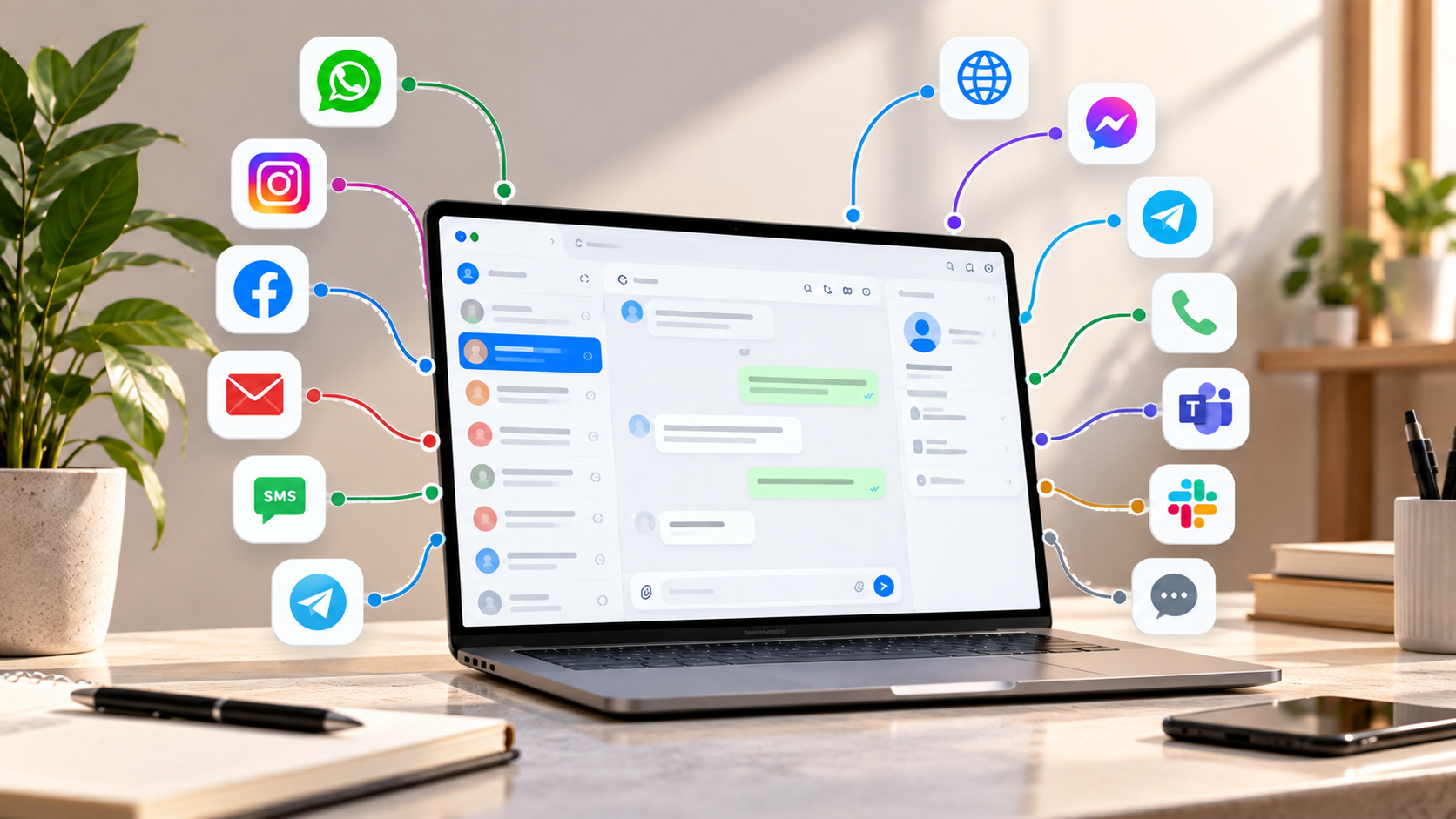
12+ communication channels connected in one place

How Businesses Can Connect 12+ Communication Channels in One Place

Customers no longer communicate with businesses through one channel. One person may send a WhatsApp message after seeing an advertisement, another may ask a question through Instagram, someone else may prefer email, while another customer starts a conversation through live chat. Depending on the market and audience, businesses may also need to communicate through SMS, Telegram, Messenger, voice, and other platforms.

Being available across these channels gives customers more freedom to communicate in the way they prefer. For the business, however, every additional channel can create another place that employees need to check, manage, and remember. The problem becomes especially visible as customer conversations increase.

A sales executive may be responding to WhatsApp enquiries while the marketing team manages Instagram messages. Support requests arrive through email, website visitors use live chat, and other customer conversations remain spread across different applications. Employees constantly move between tabs, notifications, accounts, and dashboards simply to understand who needs a response. The solution is not necessarily to reduce the number of channels customers can use. It is to bring those channels together through a Unified Inbox so the business can manage communication from one place.

With a platform such as ihakimi, businesses can connect and manage communication across 12+ channels, giving teams a central environment for handling conversations while customers continue using the channels they already prefer. But what does connecting multiple channels actually change for a business, and how can it be done effectively?

The Growing Challenge of Managing Multiple Communication Channels

At first, managing customer communication separately may not seem difficult. A business opens WhatsApp Web for WhatsApp conversations, checks Instagram for direct messages, keeps an email inbox open, monitors Facebook, and uses another dashboard for website chat. If the number of daily conversations is relatively small, employees may be able to keep up.

As the business grows, the same setup becomes increasingly difficult to manage. The challenge is not that WhatsApp, Instagram, email, or any other individual channel is difficult to use. The challenge is that every platform creates a separate communication environment.

Employees need to remember where a particular conversation happened. They may not know whether another team member has already responded. Customer information can be scattered across different applications, and managers have limited visibility into the overall volume of conversations. Even something as simple as checking unanswered messages becomes more complicated when there is no single place to look. The more communication channels a business adds, the more important the system behind those channels becomes.

Why Customer Channel Preferences Matter

The easiest solution might appear to be forcing everyone into one communication channel. A business could decide that all support enquiries must come through email or that every sales conversation should happen through WhatsApp. Operationally, that may seem simpler, but it places the convenience of the business ahead of the convenience of the customer. Different customers naturally prefer different channels.

Someone browsing Instagram may find it easier to send a DM than leave the application and search for an email address. A returning customer may already have the company’s WhatsApp conversation available on their phone. Another person may prefer email for a detailed business enquiry, while someone visiting the website may simply want to ask a quick question through live chat.

The objective of centralized communication is therefore not to make every customer use the same channel. It is to let customers communicate through different channels while allowing the business to manage those interactions through a more unified system. That difference is important. From the customer’s perspective, nothing needs to become complicated. They continue sending messages through familiar platforms. The centralization happens behind the scenes for the business.

Understanding Centralized Multi-Channel Communication

Connecting multiple communication channels means bringing conversations from different customer touchpoints into a centralized communication environment. Instead of treating WhatsApp, Instagram, Messenger, email, SMS, Telegram, website chat, and other supported channels as completely separate inboxes, teams can work from a common system. This creates a very different workflow.

Imagine that a business receives 200 customer conversations during a day across several channels. Without centralization, employees may need to repeatedly check each application to understand what is happening. With a unified system, those conversations can become part of one operational environment where teams can view, respond to, organize, assign, and automate communication. The channels still exist independently from the customer’s perspective. A WhatsApp customer continues using WhatsApp. An Instagram customer continues using Instagram. What changes is the way the business handles those conversations internally.

This is where ihakimi’s Unified Inbox becomes important. Instead of asking teams to manage customer communication through a collection of disconnected applications, conversations from supported channels can be handled within a central workspace.

The Business Value of Supporting Multiple Communication Channels

Supporting multiple channels is useful because customer communication habits are not identical across every audience, industry, or country. Some businesses receive most of their enquiries through WhatsApp. Others may depend heavily on Instagram or Facebook. B2B organizations might receive more detailed enquiries through email, while digital-first companies may see significant website chat activity. Other audiences may prefer Telegram, SMS, or different messaging platforms.

There is no single communication channel that works equally well for every customer. ihakimi’s support for 12+ communication channels allows businesses to build a broader communication ecosystem rather than designing their entire customer experience around one platform. However, the number of channels is only part of the value. Connecting 12+ channels would not solve much if the business still had to operate them as 12 completely independent inboxes. The bigger advantage comes from combining broad channel availability with centralized conversation management. The goal is not simply more channels. It is more channels without creating more operational confusion.

How a Unified Inbox Improves Communication Management

A unified inbox is often described as a convenient place to read messages, but its impact can go much further. When customer conversations are brought into one environment, teams no longer need to organize their day around checking separate communication applications.

A sales employee can focus on sales conversations rather than remembering whether the next lead is waiting on WhatsApp or Instagram. A support agent can focus on unresolved customer issues rather than repeatedly checking several inboxes. Managers can gain a clearer view of how communication is being handled across the team. This also reduces the dependence on individual memory.

Without a centralized system, an employee may remember that a customer needs a follow-up because they personally handled the earlier conversation. If that employee is unavailable, another team member may have difficulty understanding what happened. Centralization helps move customer communication away from personal memory and toward a shared operational process. That becomes increasingly valuable as the number of employees and customer conversations grows.

Creating a More Connected View of Customer Conversations

Managing multiple channels effectively is not only about seeing messages in one screen. Teams also need enough context to respond appropriately. Imagine a customer who previously spoke with the business and now returns with another question. The employee handling the new conversation should ideally be able to understand relevant previous interactions rather than making the customer explain everything again. Without connected communication, customer context can become fragmented.

One part of the conversation may exist on one channel while another employee has information somewhere else. This can result in repeated questions, inconsistent answers, and unnecessary delays. A centralized communication environment can help teams work with conversations and customer information more systematically. The goal should be that whichever team member handles the customer has enough context to continue the interaction naturally. This matters because customers generally think of themselves as communicating with one business, not with separate WhatsApp, Instagram, email, and website departments. The internal setup should reflect that reality as closely as possible.

The Role of Automation in Multi-Channel Communication

Once communication channels are centralized, businesses can begin doing more than simply responding from one inbox. They can introduce automation. Suppose a business receives the same type of enquiry repeatedly:

  • “Can you send me your catalogue?”
  • “I want to book a demo.”
  • “What are your working hours?”
  • “I need support with my order.”

Handling every repetitive enquiry manually consumes time that employees could spend on conversations requiring human judgment. With ihakimi, businesses can use tools such as the No-Code Bot Builder, triggers, conditions, automated actions, and AI capabilities to create workflows around customer conversations.

The important advantage is that automation becomes part of the broader communication strategy rather than something built for only one isolated inbox. A conversation can trigger a structured flow, information can be collected, conditions can determine the next action, and a human team member can become involved when necessary. Centralization therefore creates a foundation for both communication and automation.

How AI Supports Customer Conversations Across Channels

Managing conversations across multiple communication channels creates another challenge: volume. Even with one inbox, a growing business may receive more messages than employees can answer immediately. AI can help manage part of that workload. An AI Agent can assist with common customer questions, understand natural-language enquiries, provide approved information, collect required details, and determine when the conversation needs human involvement.

For example, a customer might ask: “Do you have a plan for a team of 20 people?” Another might write: “I paid yesterday but my account still isn’t active.” These messages represent very different intentions. One may be a sales enquiry, while the other requires support. AI can help understand that difference and guide the conversation accordingly. However, the objective should not be to make every customer conversation completely automated. Some situations require judgment, empathy, approval, negotiation, or deeper investigation. A strong communication workflow therefore combines AI and automation with human handoff. The customer receives faster assistance where automation is appropriate while the team remains available when a person needs to take over.

Effective Conversation Routing and Team Assignment

Bringing different communication channels into one inbox creates visibility, but businesses still need a clear way to decide who handles each conversation. Without assignment rules, a unified inbox can simply become a larger shared inbox where everyone sees everything. That is not necessarily better. The next step is routing.

Sales enquiries may need to go to the sales team. Support questions should reach customer service. Billing issues may require accounts, while certain high-value enquiries might need a specific team member. ihakimi’s automation, assignment, pipelines, tickets, and routing capabilities can help businesses create more structured handling of incoming conversations.

Depending on the workflow, conversations can be assigned to responsible users, distributed among team members, or moved into appropriate processes. For sales teams, this can mean automatically distributing new opportunities rather than having employees manually choose leads. For support teams, it can mean creating a clearer path from customer enquiry to resolution. Centralized communication works best when every conversation has not only a place to arrive but also a clear next step.

Maintaining a Consistent Customer Experience Across Channels

One of the risks of managing communication separately is inconsistency. An Instagram customer may receive one answer while a WhatsApp customer receives another. Email responses may sound highly formal while social messaging is completely different. One team promises something another team does not know about. Some variation between channels is natural. A WhatsApp response may be shorter than an email, and social messaging may feel more conversational. But the underlying information and customer experience should remain consistent.

Centralizing communication can make it easier for businesses to establish common workflows, approved information, automation rules, templates, and AI instructions. The objective is not to make every message identical. It is to ensure that customers receive the same standard of communication regardless of where the conversation begins.

A Typical Multi-Channel Customer Journey in Practice

A customer journey rarely stays as simple as:

Customer sends message → Business replies → Conversation ends.

Consider a potential customer who discovers a business through Instagram. They send a DM asking for more information. After receiving an initial response, they later continue the discussion through WhatsApp because it is more convenient for them. They visit the company’s website to explore the service and eventually communicate with the sales team. From the customer’s perspective, this is one relationship with one business. From the business’s perspective, however, the journey may have crossed several systems.

Without centralized communication and connected workflows, different parts of that journey can become disconnected. Now consider a system where communication channels feed into a shared environment. The team has greater visibility, automation can handle repetitive stages, customer information can be organized, and responsibility can move to the appropriate person when necessary. The experience becomes easier to manage internally without asking the customer to change how they prefer to communicate. That is the practical value of an omnichannel approach.

Improving Communication Visibility and Performance Insights

When conversations are scattered across separate platforms, understanding communication performance becomes difficult. How quickly are customers receiving responses? Which channels generate the most conversations? Where are customers engaging? How are team members handling enquiries? Are conversations resulting in meaningful outcomes? If every channel exists in isolation, answering these questions may require collecting information from several different systems.

A centralized platform can make communication analytics more useful because businesses can evaluate activity from a broader perspective. ihakimi includes analytics around areas such as response time, engagement, conversions, and channel performance, helping businesses understand more than simply how many messages they received. That visibility can reveal operational problems that might otherwise remain hidden.

A business may discover that one channel generates a large number of leads but responses are consistently slower there. Another channel may create fewer conversations but stronger engagement. A particular team may be receiving more enquiries than it can reasonably handle. Centralized communication therefore creates opportunities not only to manage conversations but also to improve the processes behind them.

Managing 12+ Communication Channels With ihakimi

ihakimi is designed to help businesses manage customer communication across 12+ channels from a more connected environment. Instead of building separate processes for every communication platform, businesses can bring supported channels into the Unified Inbox and then build workflows around those conversations. The platform goes beyond simply displaying messages.

Businesses can use the No-Code Bot Builder to create structured conversation flows, AI Agents to handle more flexible customer interactions, triggers and conditions to automate actions, pipelines to manage opportunities, tickets to organize support issues, and assignment capabilities to route conversations to the appropriate team members. Broadcasts and drip campaigns can support proactive communication, while analytics provide visibility into how customers and teams are interacting across the communication environment. Integrations, API actions, inbound webhooks, and other automation tools can also connect customer conversations with wider business processes when required. The result is not simply a larger inbox. It is an environment where channels, conversations, automation, AI, teams, and customer workflows can work together.

Choosing the Right Communication Channels for Your Business

Supporting 12+ channels does not mean every business needs to use all of them. A company whose customers primarily use WhatsApp, Instagram, email, and website chat may have no reason to activate several additional channels immediately. The better approach is to start with the channels customers genuinely use.

As the business expands into new markets, reaches new audiences, or introduces new communication strategies, additional channels can be added when they serve a clear purpose. The advantage of a multi-channel platform is flexibility. Businesses are not forced to build a completely different communication setup every time a new channel becomes relevant. The system can grow alongside the communication needs of the business.

Wrapping It Up

Customers are becoming more distributed across communication channels, but business teams do not need to become equally fragmented. WhatsApp, Instagram, Facebook, email, SMS, Telegram, website chat, voice, and other communication platforms all give customers different ways to reach a business. That accessibility can be valuable, but only when the organization has a practical way to manage the conversations behind it.

Connecting channels through a Unified Inbox changes the operational model. Instead of employees repeatedly switching between applications, customer conversations can become part of a centralized workflow. Automation can handle repetitive interactions, AI can assist with common enquiries, conversations can be routed to appropriate team members, and managers can gain greater visibility into communication performance. Most importantly, customers do not need to adapt to the internal structure of the business. They can continue communicating through the channels they prefer.

With ihakimi, businesses can bring 12+ communication channels into a more unified customer engagement environment and connect those conversations with automation, AI, team workflows, tickets, pipelines, broadcasts, and analytics. The goal is not simply to be present everywhere. It is to make sure that as customers communicate from more places, the business can still manage those conversations as one connected operation.

As customer communication continues to expand across more communication channels, the businesses that manage it effectively will not necessarily be the ones using the most channels, but the ones connecting those channels with the right processes behind them. Bringing conversations, teams, automation, AI, and customer information into a more coordinated environment can make communication easier to manage as the business grows. With ihakimi, businesses can build that connected approach while continuing to meet customers on the channels they already use, creating a communication system that is more organized, responsive, and ready to scale.

How Businesses Can Connect 12+ Communication Channels in One Place

Customers no longer communicate with businesses through one channel. One person may send a WhatsApp message after seeing an advertisement, another may ask a question through Instagram, someone else may prefer email, while another customer starts a conversation through live chat. Depending on the market and audience, businesses may also need to communicate through SMS, Telegram, Messenger, voice, and other platforms.

Being available across these channels gives customers more freedom to communicate in the way they prefer. For the business, however, every additional channel can create another place that employees need to check, manage, and remember. The problem becomes especially visible as customer conversations increase.

A sales executive may be responding to WhatsApp enquiries while the marketing team manages Instagram messages. Support requests arrive through email, website visitors use live chat, and other customer conversations remain spread across different applications. Employees constantly move between tabs, notifications, accounts, and dashboards simply to understand who needs a response. The solution is not necessarily to reduce the number of channels customers can use. It is to bring those channels together through a Unified Inbox so the business can manage communication from one place.

With a platform such as ihakimi, businesses can connect and manage communication across 12+ channels, giving teams a central environment for handling conversations while customers continue using the channels they already prefer. But what does connecting multiple channels actually change for a business, and how can it be done effectively?

The Growing Challenge of Managing Multiple Communication Channels

At first, managing customer communication separately may not seem difficult. A business opens WhatsApp Web for WhatsApp conversations, checks Instagram for direct messages, keeps an email inbox open, monitors Facebook, and uses another dashboard for website chat. If the number of daily conversations is relatively small, employees may be able to keep up.

As the business grows, the same setup becomes increasingly difficult to manage. The challenge is not that WhatsApp, Instagram, email, or any other individual channel is difficult to use. The challenge is that every platform creates a separate communication environment.

Employees need to remember where a particular conversation happened. They may not know whether another team member has already responded. Customer information can be scattered across different applications, and managers have limited visibility into the overall volume of conversations. Even something as simple as checking unanswered messages becomes more complicated when there is no single place to look. The more communication channels a business adds, the more important the system behind those channels becomes.

Why Customer Channel Preferences Matter

The easiest solution might appear to be forcing everyone into one communication channel. A business could decide that all support enquiries must come through email or that every sales conversation should happen through WhatsApp. Operationally, that may seem simpler, but it places the convenience of the business ahead of the convenience of the customer. Different customers naturally prefer different channels.

Someone browsing Instagram may find it easier to send a DM than leave the application and search for an email address. A returning customer may already have the company’s WhatsApp conversation available on their phone. Another person may prefer email for a detailed business enquiry, while someone visiting the website may simply want to ask a quick question through live chat.

The objective of centralized communication is therefore not to make every customer use the same channel. It is to let customers communicate through different channels while allowing the business to manage those interactions through a more unified system. That difference is important. From the customer’s perspective, nothing needs to become complicated. They continue sending messages through familiar platforms. The centralization happens behind the scenes for the business.

Understanding Centralized Multi-Channel Communication

Connecting multiple communication channels means bringing conversations from different customer touchpoints into a centralized communication environment. Instead of treating WhatsApp, Instagram, Messenger, email, SMS, Telegram, website chat, and other supported channels as completely separate inboxes, teams can work from a common system. This creates a very different workflow.

Imagine that a business receives 200 customer conversations during a day across several channels. Without centralization, employees may need to repeatedly check each application to understand what is happening. With a unified system, those conversations can become part of one operational environment where teams can view, respond to, organize, assign, and automate communication. The channels still exist independently from the customer’s perspective. A WhatsApp customer continues using WhatsApp. An Instagram customer continues using Instagram. What changes is the way the business handles those conversations internally.

This is where ihakimi’s Unified Inbox becomes important. Instead of asking teams to manage customer communication through a collection of disconnected applications, conversations from supported channels can be handled within a central workspace.

The Business Value of Supporting Multiple Communication Channels

Supporting multiple channels is useful because customer communication habits are not identical across every audience, industry, or country. Some businesses receive most of their enquiries through WhatsApp. Others may depend heavily on Instagram or Facebook. B2B organizations might receive more detailed enquiries through email, while digital-first companies may see significant website chat activity. Other audiences may prefer Telegram, SMS, or different messaging platforms.

There is no single communication channel that works equally well for every customer. ihakimi’s support for 12+ communication channels allows businesses to build a broader communication ecosystem rather than designing their entire customer experience around one platform. However, the number of channels is only part of the value. Connecting 12+ channels would not solve much if the business still had to operate them as 12 completely independent inboxes. The bigger advantage comes from combining broad channel availability with centralized conversation management. The goal is not simply more channels. It is more channels without creating more operational confusion.

How a Unified Inbox Improves Communication Management

A unified inbox is often described as a convenient place to read messages, but its impact can go much further. When customer conversations are brought into one environment, teams no longer need to organize their day around checking separate communication applications.

A sales employee can focus on sales conversations rather than remembering whether the next lead is waiting on WhatsApp or Instagram. A support agent can focus on unresolved customer issues rather than repeatedly checking several inboxes. Managers can gain a clearer view of how communication is being handled across the team. This also reduces the dependence on individual memory.

Without a centralized system, an employee may remember that a customer needs a follow-up because they personally handled the earlier conversation. If that employee is unavailable, another team member may have difficulty understanding what happened. Centralization helps move customer communication away from personal memory and toward a shared operational process. That becomes increasingly valuable as the number of employees and customer conversations grows.

Creating a More Connected View of Customer Conversations

Managing multiple channels effectively is not only about seeing messages in one screen. Teams also need enough context to respond appropriately. Imagine a customer who previously spoke with the business and now returns with another question. The employee handling the new conversation should ideally be able to understand relevant previous interactions rather than making the customer explain everything again. Without connected communication, customer context can become fragmented.

One part of the conversation may exist on one channel while another employee has information somewhere else. This can result in repeated questions, inconsistent answers, and unnecessary delays. A centralized communication environment can help teams work with conversations and customer information more systematically. The goal should be that whichever team member handles the customer has enough context to continue the interaction naturally. This matters because customers generally think of themselves as communicating with one business, not with separate WhatsApp, Instagram, email, and website departments. The internal setup should reflect that reality as closely as possible.

The Role of Automation in Multi-Channel Communication

Once communication channels are centralized, businesses can begin doing more than simply responding from one inbox. They can introduce automation. Suppose a business receives the same type of enquiry repeatedly:

  • “Can you send me your catalogue?”
  • “I want to book a demo.”
  • “What are your working hours?”
  • “I need support with my order.”

Handling every repetitive enquiry manually consumes time that employees could spend on conversations requiring human judgment. With ihakimi, businesses can use tools such as the No-Code Bot Builder, triggers, conditions, automated actions, and AI capabilities to create workflows around customer conversations.

The important advantage is that automation becomes part of the broader communication strategy rather than something built for only one isolated inbox. A conversation can trigger a structured flow, information can be collected, conditions can determine the next action, and a human team member can become involved when necessary. Centralization therefore creates a foundation for both communication and automation.

How AI Supports Customer Conversations Across Channels

Managing conversations across multiple communication channels creates another challenge: volume. Even with one inbox, a growing business may receive more messages than employees can answer immediately. AI can help manage part of that workload. An AI Agent can assist with common customer questions, understand natural-language enquiries, provide approved information, collect required details, and determine when the conversation needs human involvement.

For example, a customer might ask: “Do you have a plan for a team of 20 people?” Another might write: “I paid yesterday but my account still isn’t active.” These messages represent very different intentions. One may be a sales enquiry, while the other requires support. AI can help understand that difference and guide the conversation accordingly. However, the objective should not be to make every customer conversation completely automated. Some situations require judgment, empathy, approval, negotiation, or deeper investigation. A strong communication workflow therefore combines AI and automation with human handoff. The customer receives faster assistance where automation is appropriate while the team remains available when a person needs to take over.

Effective Conversation Routing and Team Assignment

Bringing different communication channels into one inbox creates visibility, but businesses still need a clear way to decide who handles each conversation. Without assignment rules, a unified inbox can simply become a larger shared inbox where everyone sees everything. That is not necessarily better. The next step is routing.

Sales enquiries may need to go to the sales team. Support questions should reach customer service. Billing issues may require accounts, while certain high-value enquiries might need a specific team member. ihakimi’s automation, assignment, pipelines, tickets, and routing capabilities can help businesses create more structured handling of incoming conversations.

Depending on the workflow, conversations can be assigned to responsible users, distributed among team members, or moved into appropriate processes. For sales teams, this can mean automatically distributing new opportunities rather than having employees manually choose leads. For support teams, it can mean creating a clearer path from customer enquiry to resolution. Centralized communication works best when every conversation has not only a place to arrive but also a clear next step.

Maintaining a Consistent Customer Experience Across Channels

One of the risks of managing communication separately is inconsistency. An Instagram customer may receive one answer while a WhatsApp customer receives another. Email responses may sound highly formal while social messaging is completely different. One team promises something another team does not know about. Some variation between channels is natural. A WhatsApp response may be shorter than an email, and social messaging may feel more conversational. But the underlying information and customer experience should remain consistent.

Centralizing communication can make it easier for businesses to establish common workflows, approved information, automation rules, templates, and AI instructions. The objective is not to make every message identical. It is to ensure that customers receive the same standard of communication regardless of where the conversation begins.

A Typical Multi-Channel Customer Journey in Practice

A customer journey rarely stays as simple as:

Customer sends message → Business replies → Conversation ends.

Consider a potential customer who discovers a business through Instagram. They send a DM asking for more information. After receiving an initial response, they later continue the discussion through WhatsApp because it is more convenient for them. They visit the company’s website to explore the service and eventually communicate with the sales team. From the customer’s perspective, this is one relationship with one business. From the business’s perspective, however, the journey may have crossed several systems.

Without centralized communication and connected workflows, different parts of that journey can become disconnected. Now consider a system where communication channels feed into a shared environment. The team has greater visibility, automation can handle repetitive stages, customer information can be organized, and responsibility can move to the appropriate person when necessary. The experience becomes easier to manage internally without asking the customer to change how they prefer to communicate. That is the practical value of an omnichannel approach.

Improving Communication Visibility and Performance Insights

When conversations are scattered across separate platforms, understanding communication performance becomes difficult. How quickly are customers receiving responses? Which channels generate the most conversations? Where are customers engaging? How are team members handling enquiries? Are conversations resulting in meaningful outcomes? If every channel exists in isolation, answering these questions may require collecting information from several different systems.

A centralized platform can make communication analytics more useful because businesses can evaluate activity from a broader perspective. ihakimi includes analytics around areas such as response time, engagement, conversions, and channel performance, helping businesses understand more than simply how many messages they received. That visibility can reveal operational problems that might otherwise remain hidden.

A business may discover that one channel generates a large number of leads but responses are consistently slower there. Another channel may create fewer conversations but stronger engagement. A particular team may be receiving more enquiries than it can reasonably handle. Centralized communication therefore creates opportunities not only to manage conversations but also to improve the processes behind them.

Managing 12+ Communication Channels With ihakimi

ihakimi is designed to help businesses manage customer communication across 12+ channels from a more connected environment. Instead of building separate processes for every communication platform, businesses can bring supported channels into the Unified Inbox and then build workflows around those conversations. The platform goes beyond simply displaying messages.

Businesses can use the No-Code Bot Builder to create structured conversation flows, AI Agents to handle more flexible customer interactions, triggers and conditions to automate actions, pipelines to manage opportunities, tickets to organize support issues, and assignment capabilities to route conversations to the appropriate team members. Broadcasts and drip campaigns can support proactive communication, while analytics provide visibility into how customers and teams are interacting across the communication environment. Integrations, API actions, inbound webhooks, and other automation tools can also connect customer conversations with wider business processes when required. The result is not simply a larger inbox. It is an environment where channels, conversations, automation, AI, teams, and customer workflows can work together.

Choosing the Right Communication Channels for Your Business

Supporting 12+ channels does not mean every business needs to use all of them. A company whose customers primarily use WhatsApp, Instagram, email, and website chat may have no reason to activate several additional channels immediately. The better approach is to start with the channels customers genuinely use.

As the business expands into new markets, reaches new audiences, or introduces new communication strategies, additional channels can be added when they serve a clear purpose. The advantage of a multi-channel platform is flexibility. Businesses are not forced to build a completely different communication setup every time a new channel becomes relevant. The system can grow alongside the communication needs of the business.

Wrapping It Up

Customers are becoming more distributed across communication channels, but business teams do not need to become equally fragmented. WhatsApp, Instagram, Facebook, email, SMS, Telegram, website chat, voice, and other communication platforms all give customers different ways to reach a business. That accessibility can be valuable, but only when the organization has a practical way to manage the conversations behind it.

Connecting channels through a Unified Inbox changes the operational model. Instead of employees repeatedly switching between applications, customer conversations can become part of a centralized workflow. Automation can handle repetitive interactions, AI can assist with common enquiries, conversations can be routed to appropriate team members, and managers can gain greater visibility into communication performance. Most importantly, customers do not need to adapt to the internal structure of the business. They can continue communicating through the channels they prefer.

With ihakimi, businesses can bring 12+ communication channels into a more unified customer engagement environment and connect those conversations with automation, AI, team workflows, tickets, pipelines, broadcasts, and analytics. The goal is not simply to be present everywhere. It is to make sure that as customers communicate from more places, the business can still manage those conversations as one connected operation.

As customer communication continues to expand across more communication channels, the businesses that manage it effectively will not necessarily be the ones using the most channels, but the ones connecting those channels with the right processes behind them. Bringing conversations, teams, automation, AI, and customer information into a more coordinated environment can make communication easier to manage as the business grows. With ihakimi, businesses can build that connected approach while continuing to meet customers on the channels they already use, creating a communication system that is more organized, responsive, and ready to scale.

Scroll to Top